criminal defense lawyer NC: The Truth About “Unlawful Entry” Cases
criminal defense lawyer NC explains why “unlawful entry” charges get dismissed—and what to do now. Learn your rights and next steps. Call 1-844-967-3536.
Vasquez Law Firm
Published on December 22, 2025
criminal defense lawyer NC: The Truth About “Unlawful Entry” Cases
If you saw the news about a Dubai court clearing a man accused of unlawful entry into a rented villa, you might be wondering: could the same thing happen here? A criminal defense lawyer NC sees this pattern often—cases that look “open and shut” until the evidence is tested, the definition of consent is examined, and the state’s burden of proof is enforced.
Quick Summary (Read This First)
What happened: A Dubai court reportedly cleared a man accused of unlawful entry into a rented villa after the evidence did not support the accusation.
Why it matters to you: In North Carolina, “unlawful entry” is often charged as trespass or breaking/entering, and these cases can turn on consent, identity, and whether the state can prove every element beyond a reasonable doubt.
What to do now: Preserve messages, rental agreements, door codes, and witness info—and avoid “explaining” your way out to police without counsel.
What This News Means for North Carolina Residents
Why “unlawful entry” cases sometimes fall apart
In the Dubai story, the key takeaway is simple: an accusation is not proof. Courts still require reliable evidence, tested evidence, and a clear legal theory. You can read the report here: Dubai court clears man accused of unlawful entry into rented villa (Gulf News via Google News).
Serving North Carolina residents, we see similar themes when a guest enters the wrong unit, a former partner uses an old code, a tenant dispute turns criminal, or a property manager reports “unauthorized entry” after a misunderstanding. A criminal defense lawyer NC focuses on the gap between what someone believes happened and what the state can actually prove.
What “unlawful entry” usually means in North Carolina
North Carolina does not use one single charge called “unlawful entry” in the same way many headlines do. Instead, prosecutors may use charges like:
- First-degree trespass (often tied to entering or remaining on certain premises after being notified not to enter)
- Second-degree trespass (entering or remaining after being told not to, or entering posted property)
- Breaking or entering (a more serious allegation, often connected to “wrongful” entry into buildings)
- Burglary (rare in “rental misunderstanding” cases, but sometimes alleged when the state claims intent to commit a crime inside)
Why this news should get your attention
Even when you feel confident you “did nothing wrong,” these cases can move fast: arrest, bond conditions, no-contact orders, and court dates. And once a charge is filed, it can affect housing, jobs, professional licensing, and immigration.
KEY TAKEAWAY:
In a trespass or “unlawful entry” case, the fight is often about consent, identity, and proof—not about who is louder or more confident when police arrive.
What to Do in the Next 24-48 Hours
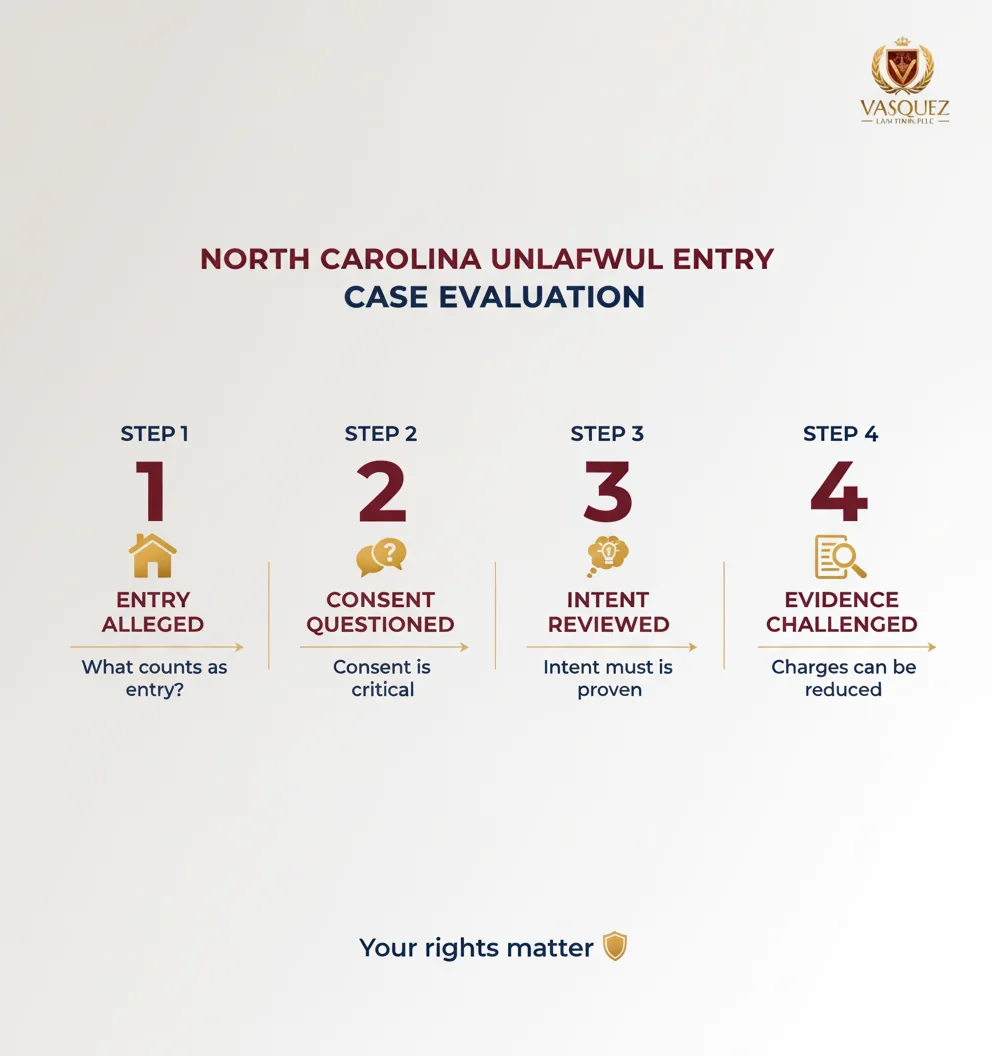
Your goal: preserve proof and avoid preventable mistakes
In the first 1–2 days, people often delete the very messages that would have cleared things up. They also try to “fix it” by talking—creating statements the state can later use out of context.
If this situation applies to you, take these steps NOW:
- Step 1: Document everything: screenshot texts, emails, app messages (Airbnb/VRBO), door-code history, call logs, and timestamps.
- Step 2: Write a clean timeline while it’s fresh: where you were, who invited you, what you were told, and who can confirm it.
- Step 3: Identify and preserve third-party proof: camera footage, key fob logs, hotel front-desk notes, GPS history, or ride-share receipts.
- Step 4: Consult with a legal expert to understand your rights and options.
Avoid the “helpful explanation” trap
In North Carolina, police may ask for a “quick statement” to “clear this up.” But your words can become the centerpiece of the case. A common problem: you admit you entered the property, thinking that ends it—while the state tries to argue you “knew” you weren’t allowed.
If you’ve already been charged or served with papers
Do not miss court. Do not violate bond conditions. And do not contact the complaining witness if there is any no-contact order (even indirect contact can count).
Warning Signs & Red Flags to Watch For
These red flags often signal the case is getting more serious
These are signs your case may be in jeopardy:

- The report says you “forced entry,” but there’s no damage—or the lock was coded/unlocked.
- You are being accused by a landlord/property manager during a lease or refund dispute.
- Police are pressuring you to “just admit you went in” or to sign a written statement.
- There are conflicting stories about whether you had permission (texts say yes; witness says no).
- The allegation is being upgraded to breaking/entering or burglary based on assumptions about intent.
Seeing these signs? Vasquez Law Firm, PLLC has handled hundreds of denied claims in North Carolina. Attorney Vasquez knows the tactics insurers use. Get a free case evaluation.
Why timing matters in property-entry allegations
Surveillance footage can be overwritten. Door-access logs can be purged. Witness memories fade. Early action helps preserve proof that supports your defense.
Your Rights: What You CAN and CANNOT Do
Rights during police contact in North Carolina
YOU HAVE THE RIGHT TO:
- Remain silent and decline to answer investigative questions beyond basic identification.
- Refuse consent to a search of your phone or your home (police may still seek a warrant).
- Ask if you are free to leave and end the encounter if you are not detained.
- Have your lawyer communicate with law enforcement on your behalf.
YOU CANNOT:
- Assume “permission” is obvious—if there is a dispute, your words can be framed as “knowledge” you weren’t allowed.
- Contact a complaining witness if a court order or bond condition prohibits it.
- Delete messages, reset devices, or “clean up” accounts—this can look like consciousness of guilt.
Vasquez Law Firm, PLLC helps North Carolina clients understand and protect their rights every day.
Consent: the issue people underestimate
Many “unlawful entry” allegations are really arguments over permission: Who gave it? Was it revoked? Did you reasonably believe you had it? A strong defense often comes from objective proof (messages, access logs, payment records), not from last-minute explanations.
Documents You'll Need (Save This Checklist)
Proof that you had permission (or believed you did)
Gather these documents NOW (before they disappear):
- Lease, rental agreement, or booking confirmation (including dates, unit number, and authorized guests).
- Texts/emails/app messages showing invitation, permission, check-in instructions, or door codes.
- Payment proof: receipts, bank statements, or app payment history.
- Photos/video of doors/locks (no damage), signage, and unit numbers (to show confusion or mislabeling).
- Witness contact info: neighbors, front desk, co-travelers, property staff, rideshare drivers.
- Any body-cam references, incident report numbers, or officer names (write down what you remember).
Tip: Keep all documents organized in one folder - it makes the process much easier.
Digital evidence to preserve (often overlooked)
If the dispute involves a smart lock, app access, or building entry systems, preserve anything showing you used a valid credential (temporary code, fob access, or a host-generated link). If you can lawfully obtain your own records, do it quickly.
KEY TAKEAWAY:
In many “unlawful entry” cases, the best defense is boring but powerful: paperwork + timestamps. Screenshots and access logs can create reasonable doubt fast.
Legal Background and Context
How trespass is defined and charged in North Carolina
In North Carolina, trespass laws are primarily found in Chapter 14 of the General Statutes. The exact charge depends on where you entered, what notice was given, and whether you refused to leave. You can review North Carolina court processes and resources at the North Carolina Judicial Branch (nccourts.gov).
Two commonly charged trespass statutes include:
- N.C. Gen. Stat. § 14-159.12 (first-degree trespass)
- N.C. Gen. Stat. § 14-159.13 (second-degree trespass)
For the statutory text, you can also use the North Carolina General Assembly site: North Carolina General Assembly (ncleg.gov).
Trespass vs. breaking/entering: why the label matters
Prosecutors sometimes file breaking/entering charges when they believe the entry was into a building and was “wrongful,” even if there was no physical “break.” These charges carry higher stakes than a simple trespass allegation.
A criminal defense lawyer NC will look closely at the state’s proof of:

- Identity (was it really you on the video?)
- Notice/consent (were you told not to enter, or did you reasonably believe you could?)
- Intent (in more serious charges, what did the state claim you planned to do inside?)
How the Dubai acquittal maps onto an NC defense strategy
The Dubai acquittal highlights a universal principle: the government must prove the accusation with credible evidence. In North Carolina courtrooms—from Mecklenburg County to Wake County—the same principle applies. If the state cannot prove each element beyond a reasonable doubt, the case should be dismissed or result in a not-guilty verdict.
How Vasquez Law Firm, PLLC Helps North Carolina Clients Win These Cases
A defense built for fast-moving, fact-heavy accusations
Vasquez Law Firm, PLLC focuses on practical criminal defense. Attorney Vasquez, JD, has 15 years of experience and is admitted to the North Carolina State Bar and the Florida Bar. Our team is bilingual—Se Habla Español—because clear communication matters when everything feels urgent.
Our experienced team, led by Attorney Vasquez, has helped hundreds of North Carolina clients. Here's exactly how we help:
- Step 1: We evaluate the state’s theory and identify the element they will struggle to prove (consent, notice, identity, intent).
- Step 2: We lock down evidence early: messages, access logs, witness statements, and any footage that can disappear.
- Step 3: We challenge weak evidence through motions and negotiation, including suppression issues when applicable.
- Step 4: We prepare for trial from day one, so you’re not forced into a bad outcome due to lack of leverage.
Real example (how “permission” becomes the turning point)
Real example: “We recently defended a client accused of entering a residence without permission after a dispute about who was allowed inside. The initial story sounded damaging. We gathered messages, timeline proof, and witness context that showed the situation was not what it looked like. After pushing back hard on the state’s ability to prove lack of consent beyond a reasonable doubt, we achieved a favorable outcome.” — Attorney Vasquez
What you should expect in the first court dates
Most clients want to know: will this end quickly? Sometimes it can—especially if the evidence clearly supports a misunderstanding. But courts still move on schedules, and prosecutors may wait for more information (witness interviews, footage, lab results). The best position is a documented defense that is ready early.
Frequently Asked Questions (Specific to This Situation)
Questions people ask after hearing about an “unlawful entry” acquittal
- If I entered the wrong rental unit by mistake in North Carolina, is that still trespass? It can be charged, but mistake and lack of intent matter. Evidence showing confusion (wrong unit number, bad directions, identical doors, incorrect host instructions) can support a defense.
- Does having a door code or key defeat an unlawful entry charge? Not automatically. The state may argue the code was old, revoked, or shared without authority. Preserving the message that provided the code is often critical.
- Can a landlord turn a lease dispute into criminal trespass? It happens. But landlord-tenant disputes are not supposed to be “shortcut” evictions through criminal charges. The defense often focuses on lawful occupancy, notice, and civil vs. criminal remedies.
How the case moves through district court
- Will I be arrested for a trespass accusation in North Carolina? Some people are cited; others are arrested—especially if police claim you refused to leave, there was a disturbance, or there is an outstanding order.
- What if the complaining witness later admits it was a misunderstanding? That helps, but it does not guarantee dismissal. The state controls charging decisions, and a witness can change stories. Written, time-stamped proof is still important.
How this can affect your record and status
- Can a trespass or breaking/entering charge affect immigration status? It can, depending on the charge, the disposition, and your status. If immigration is a concern, it’s important that your defense strategy accounts for collateral consequences.
Don't Navigate This Alone
If you're dealing with trespass, breaking/entering, or an “unlawful entry” accusation, Vasquez Law Firm, PLLC can help. With 15+ years serving North Carolina, we know what works.
Free consultation. Bilingual team. No fees unless we win.
Call Now: 1-844-967-3536
Se Habla Español - Hablamos Su Idioma
Free Legal Consultation
Discuss your case with our experienced attorneys. We're available 24/7.
Vasquez Law Firm
Legal Team
Our experienced attorneys at Vasquez Law Firm have been serving clients in North Carolina and Florida for over 20 years. We specialize in immigration, personal injury, criminal defense, workers compensation, and family law.