Immigration lawyer: WARNING—H-1B visa chaos is stranding workers
Immigration lawyer explains H-1B visa chaos and travel risks. Learn the 24–48 hour steps to protect status—then request help from Vasquez Law Firm, PLLC.
Vasquez Law Firm
Published on December 22, 2025
Immigration lawyer: WARNING—H-1B visa chaos is stranding workers
If you’re an H-1B worker (or dependent) and you travel, the rules can change fast—and the consequences can be immediate. This immigration lawyer breakdown explains how the latest reports of visa-processing chaos are leaving Indian H-1B holders stuck abroad, what it can mean for families and employers in North Carolina, and the exact steps to take now to reduce the risk of being stranded.
Quick Summary (Read This First)
What happened: News reports describe policy and processing disruptions that have left some Indian H-1B visa holders unable to get timely visa stamping and return to the U.S.
Why it matters to you: If you live or work in North Carolina and travel abroad for stamping, a delay can trigger job loss risk, lease and family disruption, and immigration-status complications.
What to do now: Pause nonessential travel, confirm your exact visa/stamping plan, and build a “return-to-U.S.” file with employer and immigration documents before you leave.
What This News Means for North Carolina Residents
Recent coverage highlights “visa chaos” affecting Indian H-1B holders who traveled and then faced delays, changing requirements, or administrative processing that prevented a timely return to the U.S. (see the source link).
Why this matters in North Carolina right now
North Carolina has a large and growing community of employment-based immigrants working in tech, healthcare, higher education, and manufacturing—especially around Charlotte, the Triangle (Raleigh/Durham/Chapel Hill), and the Triad. Many people in H-1B status eventually need visa stamping abroad to re-enter after travel, even when their U.S. work authorization is valid.
When a consulate delays stamping or places a case into “administrative processing,” the practical impact can be severe: missed start dates, inability to return to children in school, and fear that a long absence could trigger downstream immigration problems.
Who is most exposed to being stranded
This situation most often hits people who:
- Need a new visa stamp because their prior visa foil expired (even if the H-1B approval notice is valid).
- Changed employers (new H-1B petition) and are traveling soon after.
- Have any prior immigration issues (RFE history, prior denials, status gaps, complex worksite arrangements).
- Work in roles that trigger extra scrutiny (certain research, engineering, or sensitive technology fields).
The real-life domino effects for families and employers
Even a “temporary” delay can create a chain reaction: payroll interruptions, project deadlines, and HR compliance issues for the employer; and rent, childcare, and medical appointment disruptions for the family. For North Carolina residents, these issues often surface quickly if the worker is tied to an on-site role or a hybrid schedule.
KEY TAKEAWAY:
For many H-1B workers, the biggest risk is not losing the approved petition—it’s being outside the U.S. without a stamp while processing rules and timelines shift.
What to Do in the Next 24-48 Hours
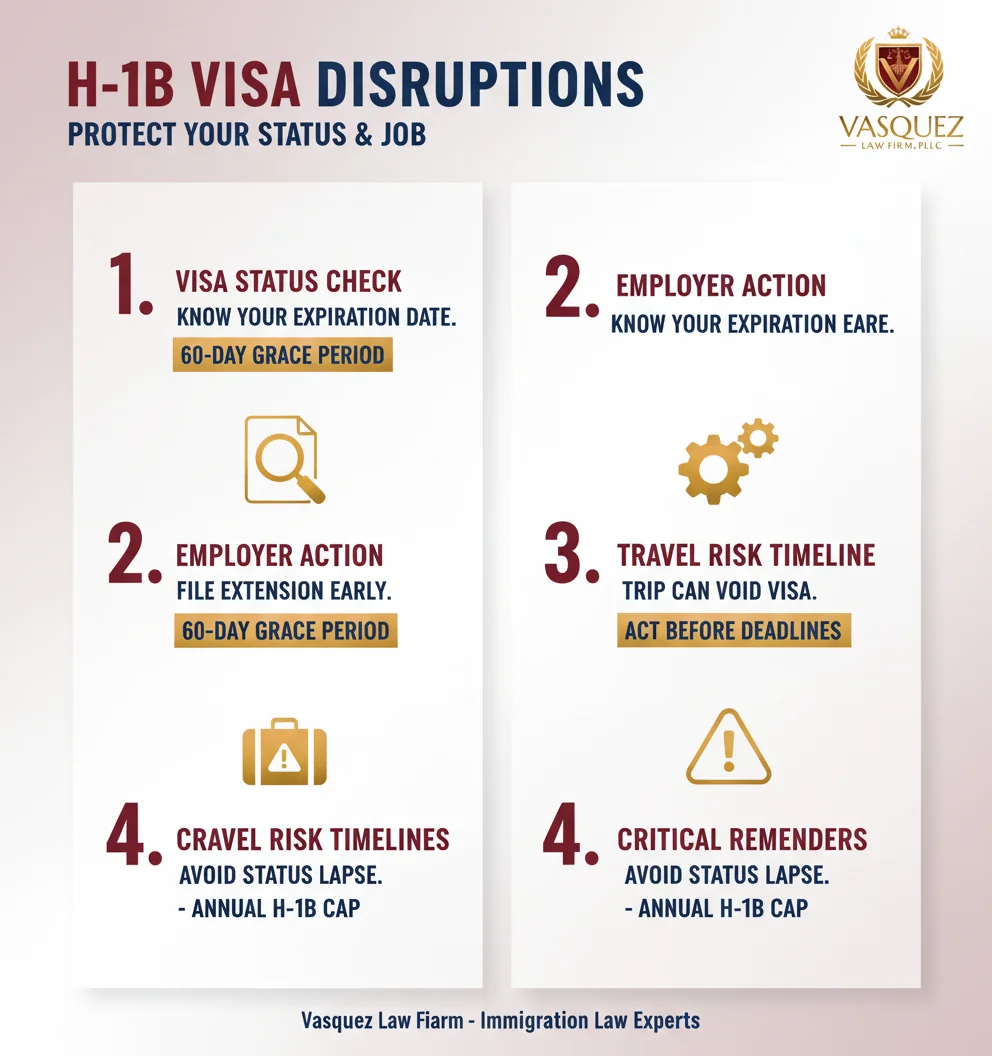
If you are considering international travel for H-1B stamping (or you are already abroad), treat the next two days like an emergency planning window. The goal is to reduce uncertainty, document everything, and keep your employer aligned with your timeline.
1) Confirm whether travel is truly required
Some people travel because they believe they “must” get a new stamp immediately. In many cases, travel is optional. If you are inside the U.S. and in valid H-1B status, you may be able to remain and work without leaving.
2) Lock in employer support and contingency planning
Ask your employer for written confirmation of role, salary, worksite, and continued need for your services. If you are delayed, you want HR and your manager prepared to document ongoing employment and avoid misunderstandings.
3) Build a “return-to-U.S.” file
Create a single folder (digital and printed) with your most important immigration and employment records. If a consular officer requests something, delays often get worse when documents are missing.
If this situation applies to you, take these steps NOW:
- Step 1: Document everything—save appointment confirmations, DS-160/appointment receipts, emails with counsel, and a timeline of travel and work dates.
- Step 2: Confirm your exact petition details (employer name, FEIN, worksite, job title, salary) match what you will say at the interview and what is in the petition.
- Step 3: Do NOT make last-minute changes (role, location, or employer) while you are abroad without legal review—small inconsistencies can trigger delays.
- Step 4: Consult with a legal expert to understand your rights and options
Warning Signs & Red Flags to Watch For
Delays happen for many reasons, and some are outside your control. But certain patterns show up again and again in cases where people end up stuck abroad for weeks or months.
Red flags that often signal a long delay
Watch for these issues before or after a visa interview:
- Repeated appointment cancellations or sudden changes to required documents.
- “Administrative processing” with no clear timeframe and no meaningful update after follow-ups.
- Requests for additional proof of specialty occupation, worksite control, or end-client documentation.
Red flags on the employer side
Your case can be jeopardized if the employer’s facts don’t line up with your petition:
- Employer cannot quickly provide an updated verification letter with consistent details.
- Worksite or reporting structure changed, but the petition was not updated (possible amendment issue).
- Salary, duties, or location differs from the Labor Condition Application (LCA) terms.
Red flags that can create status problems after return
Even if you eventually return, some choices can create longer-term consequences:

- Trying to re-enter with documents that don’t match your current employment.
- Assuming a dependent’s status is “automatic” without verifying H-4 documentation.
- Not tracking I-94 dates carefully after re-entry.
These are signs your case may be in jeopardy:
- You are told your visa is in “administrative processing” with no checklist, no timeline, and no next step.
- Your employer cannot quickly produce consistent letters, pay evidence, and LCA/worksite details.
- You receive a request suggesting a mismatch in job duties, location, or prior immigration history.
Seeing these signs? Vasquez Law Firm, PLLC has handled hundreds of denied claims in North Carolina. Attorney Vasquez knows the tactics insurers use. Get a free case evaluation.
Your Rights: What You CAN and CANNOT Do
When you’re dealing with visa delays, it’s easy to get bad advice online. The safest approach is to stick to verifiable rules, your approval notice, and official guidance. A careful immigration lawyer will also focus on consistency: your story, your documents, and your petition must match.
What you CAN do to protect yourself
YOU HAVE THE RIGHT TO:
- Ask for clarification on requested documents and keep copies of everything you submit.
- Work with counsel to prepare a clean evidence packet (petition, LCA, employer letter, pay evidence, degree evaluation if needed).
- Request that your employer provide accurate, updated employment verification—especially if your role is client-site, hybrid, or multi-location.
YOU CANNOT:
- Assume an approval notice guarantees visa issuance—consular processing is separate and can involve additional screening.
- Ignore I-94 rules after entry; your I-94 controls your authorized stay even if your visa stamp is valid.
Vasquez Law Firm, PLLC helps North Carolina clients understand and protect their rights every day.
A practical truth about visas vs. status
Many people confuse “visa stamp” with “status.” Your H-1B status is what allows you to work and remain in the U.S. while admitted; the visa stamp is what you need to request entry at a port of entry after international travel. That’s why someone can be in valid status in the U.S. but still get stuck abroad if stamping is delayed.
Use official sources (and avoid rumors)
For baseline rules, rely on official resources like USCIS and the U.S. Department of State visa information. If you have court or removal concerns (not common for H-1B workers but relevant in some mixed-status families), the Executive Office for Immigration Review (EOIR) is the official source for immigration court information.
Documents You'll Need (Save This Checklist)
When people get stranded, one common problem is that they traveled with only a passport and an approval notice. That may not be enough if the consulate requests proof of job duties, wage compliance, or a clear employer-employee relationship.
Core H-1B documents
These items typically anchor the case and reduce “back-and-forth” requests.
Employment and pay documents
Proof you are actually working under the petition terms can be critical, especially after a job change or if you have been on a bench/nonproductive period.
Family documents (H-4 spouses/children)
If your spouse or child is traveling too, align their paperwork with yours. A dependent delay can strand the whole family.
Gather these documents NOW (before they disappear):
- Current and prior H-1B approval notices (Form I-797) and a full copy of the filed petition, if available.
- Your Labor Condition Application (LCA) and wage/salary documentation that matches the petition.
- Recent pay stubs, W-2s (if available), and an employment verification letter signed by the employer.
- Resume, degree(s), transcripts, and credential evaluation (if your degree is from outside the U.S.).
- If applicable: client letters, statements of work, and worksite confirmation (especially for third-party placement).
Tip: Keep all documents organized in one folder - it makes the process much easier.
KEY TAKEAWAY:
The fastest way to turn a short delay into a long one is inconsistent paperwork. Consistency across the petition, employer letter, LCA, and your answers matters.
Legal Background and Context
H-1B employment is governed by a mix of statutes, regulations, and agency practice. While a blog post can’t predict a consulate’s internal timing, it can explain the framework that shapes what happens next.
Visas, admission, and the I-94
A visa is a travel document that allows you to seek entry; admission is granted by CBP at the port of entry; and your I-94 governs how long you are authorized to stay after entry. If you return through a major hub used by many North Carolina residents—like Charlotte Douglas International Airport—double-check your I-94 record after entry for accuracy.
Why consular processing can slow down suddenly
Consular posts can change appointment availability, document intake rules, and screening intensity. Some cases are delayed for additional review (often called “administrative processing”). These delays may be related to security checks, petition verification, or clarifying the job and employer relationship.
Key rules that often come up
Several legal concepts commonly appear in H-1B issues, including maintenance of status, eligibility for extension/change of employer, and adjustment pathways for those pursuing permanent residence. For example, adjustment of status is governed by 8 U.S.C. § 1255 for eligible applicants already in the U.S. (this is not an H-1B “fix,” but it matters for long-term planning). H-1B classification regulations are primarily found in 8 C.F.R. § 214.2(h).

How Vasquez Law Firm, PLLC Helps North Carolina Clients Win These Cases
When travel risk spikes, a strong legal strategy is about preparation, consistency, and contingency plans. Vasquez Law Firm, PLLC serves North Carolina residents with employment-based immigration needs, including H-1B and family status issues, and we focus on practical steps that reduce the odds of a delay turning into a crisis.
Our step-by-step approach
Our experienced team, led by Attorney Vasquez, has helped hundreds of North Carolina clients. Here's exactly how we help:
- Step 1: We review your facts (travel dates, prior history, employer details) and identify the top risk points.
- Step 2: We organize your evidence so your petition, employer letter, and supporting documents tell one consistent story.
- Step 3: We prepare you for common interview/document questions and create a plan for responding to additional requests.
- Step 4: If a problem happens, we coordinate with your employer and build a documented response strategy.
Why local North Carolina context matters
Serving North Carolina residents means we regularly see the same employer structures: remote work arrangements, multi-site projects, and fast-moving job changes. Those realities can create petition-document mismatches if they are not handled carefully.
Real example (what preparation can prevent)
Real example: “We assisted an H-1B professional working in North Carolina whose travel plans were at risk after a role/location change created confusion in supporting letters. We coordinated updated employer documentation, aligned the evidence with the petition terms, and created a clear ‘consistency packet’ to reduce the chance of a prolonged delay.” — Attorney Vasquez (15 years’ experience; admitted to the North Carolina State Bar and the Florida Bar; Se Habla Español)
Frequently Asked Questions (Specific to This Situation)
If I live in North Carolina and my H-1B visa stamp is expired, can I still work without traveling?
Often, yes—if you are physically in the U.S. and you were admitted in H-1B status and have not violated status, you may continue working for the petitioning employer through the validity period shown on your I-94 and approval notice. An expired visa stamp mainly affects re-entry after international travel. Because individual facts matter (especially after employer changes or moves within North Carolina), confirm with counsel before making travel decisions.
I’m abroad for stamping and my case says “administrative processing.” What should I do first?
First, preserve documentation: a screenshot of the status page, any 221(g) letter or checklist, and the date/time of all communications. Second, notify your employer (HR and manager) in writing so your absence is documented. Third, avoid submitting inconsistent “extra” documents without a plan—random uploads can create contradictions. A qualified immigration lawyer can help you build a clean, targeted response packet that matches the petition and LCA.
Does traveling during H-1B transfer (change of employer) increase the risk of getting stuck?
It can. If you travel while a change-of-employer petition is pending, timing and documentation become more sensitive. The risk increases if your start date, pay evidence, worksite details, or prior petition history are not well documented. In North Carolina, this is common when workers move quickly between projects in Charlotte or the Triangle. Get individualized advice because the safest path depends on whether the petition is filed, receipted, approved, and whether you need stamping.
My employer in North Carolina switched me to hybrid/remote work. Can that affect stamping?
Yes, if the petition and LCA were tied to a specific worksite or metropolitan area and the change was not handled properly. Consular officers may ask where you work, who supervises you, and whether the employer controls the work. If your answers don’t match the petition record, the case can be delayed. This is especially important for third-party placements and consulting roles.
What if my spouse and child (H-4) are traveling with me—can their applications delay mine?
They can be processed separately, but families often get delayed together due to shared travel schedules and document needs. Make sure each dependent has complete documentation (relationship proof, copies of the principal’s approval, and prior status records). If one case is flagged for extra review, it can disrupt the entire family’s return to North Carolina.
If I’m stranded abroad, can my North Carolina employer just keep paying me until I return?
That’s an employer compliance and HR question as well as an immigration one. Some employers can continue employment in limited ways, while others cannot due to payroll rules, tax issues, and work authorization/location policies. From an immigration standpoint, you want accurate records that reflect what actually happened and avoid creating documents that conflict with petition terms. Coordinate carefully with HR and counsel before any “workaround.”
Don't Navigate This Alone
If you're dealing with H-1B visa stamping delays or fear being stranded abroad, Vasquez Law Firm, PLLC can help. With 15+ years serving North Carolina, we know what works.
Free consultation. Bilingual team. No fees unless we win.
Call Now: 1-844-967-3536
Se Habla Español - Hablamos Su Idioma
Free Legal Consultation
Discuss your case with our experienced attorneys. We're available 24/7.
Vasquez Law Firm
Legal Team
Our experienced attorneys at Vasquez Law Firm have been serving clients in North Carolina and Florida for over 20 years. We specialize in immigration, personal injury, criminal defense, workers compensation, and family law.