traffic ticket lawyer NC: WARNING—Autopilot Hype Can Cost You
Need a traffic ticket lawyer NC residents trust? Tesla self-driving news is a wake-up call—one mistake can raise rates. Learn options and next steps.
Vasquez Law Firm
Published on December 22, 2025

traffic ticket lawyer NC: WARNING—Autopilot Hype Can Cost You
The Tesla self-driving licensing news is a reminder that “driver-assist” doesn’t mean “driver off.” If you got cited after trusting tech (or any confusing road situation), a traffic ticket lawyer NC drivers rely on can often reduce charges, protect your license, and limit insurance fallout.
Quick Summary (Read This First)
What happened: California regulators may suspend Tesla’s sales license over alleged deceptive self-driving claims.
Why it matters to you: If drivers believe “self-driving” claims, they may take risks that lead to tickets—and in North Carolina, those tickets can trigger DMV points, higher insurance, or even a suspension.
What to do now: Don’t ignore the citation. Preserve any vehicle/dashcam data and confirm your court date so you don’t accidentally miss it.
What This News Means for North Carolina Residents
Why Tesla’s “self-driving” news connects to everyday tickets
According to this news report on Tesla’s alleged deceptive self-driving claims, regulators are scrutinizing how advanced driving features are marketed.
Even though that story is based in California, it highlights a problem we see across the country: drivers can misunderstand what their car can do. That misunderstanding can lead to real-world citations like speeding, following too closely, lane violations, or inattentive driving—because the law still treats you as the person in control.
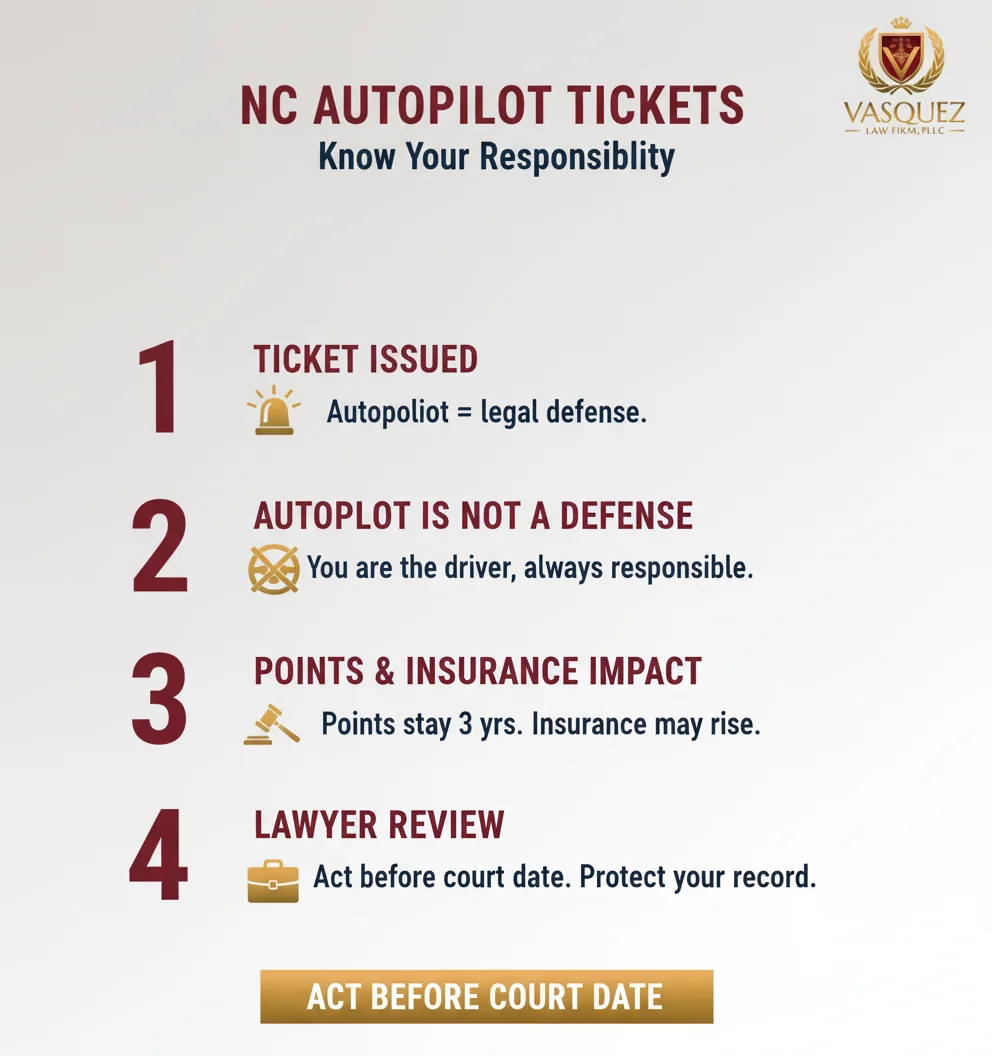
In North Carolina, “the car did it” is rarely a legal defense
In North Carolina, traffic charges usually focus on what happened on the road (speed, movement, right-of-way), not what your car’s software promised. If an officer observes a violation, the ticket is issued to the driver.
That is why speaking with a traffic ticket lawyer NC drivers trust can matter: the goal is often to challenge the evidence, negotiate a reduction, or avoid license/insurance consequences—not to argue marketing claims in traffic court.
Where “driver-assist confusion” shows up in real citations
We’re seeing more citations tied to modern driving realities, including:
- Speeding on interstates after setting cruise/assist features and not noticing a speed-limit change.
- Unsafe lane changes when blind-spot alerts are misunderstood or ignored.
- Following too closely when traffic slows suddenly and the driver relies on automation.
- Failure to maintain lane or “careless” operation allegations when a vehicle drifts.
What to Do in the Next 24-48 Hours
1) Confirm the basics on your citation (before anything else)
Most people make things worse by waiting. Within 24–48 hours, verify the details that control your case:
- Your court date and location (District Court).
- The statute/charge listed (speeding, reckless driving, improper equipment, etc.).
- Whether the citation indicates a mandatory court appearance.
2) Preserve evidence (especially tech-related data)
If your ticket involves lane movement, speed, or a crash/near-crash, preserve what you can while it still exists. Many systems overwrite data quickly.
3) Avoid the “quick fix” mistakes that backfire
Paying online can be treated as a guilty plea for many charges. And missing court can lead to an FTA and license issues. Treat the first 48 hours like evidence-preservation time.
If this situation applies to you, take these steps NOW:
- Step 1: Photograph the ticket, your license, and any roadway signs/markings near where the stop happened (date-stamp your photos).
- Step 2: Save dashcam footage and any vehicle logs you can access (speed alerts, “events,” or safety reports) before they overwrite.
- Step 3: Do NOT plead guilty or “just pay it” until you understand DMV points, insurance impact, and whether court is mandatory.
- Step 4: Consult with a legal expert to understand your rights and options
Warning Signs & Red Flags to Watch For
Red flags that usually mean the ticket is more serious than it looks
Some citations are “fix-it” style issues. Others carry real risk—especially for insurance and your driving record.
Extra risk if you’re a CDL driver or from out of state
If you drive for work, one conviction can affect employment. And if you live outside the state, a missed court date can turn into bigger problems fast.
These are signs your case may be in jeopardy:
- Your ticket says “Mandatory Court” (common with high speeds, school zones, or certain misdemeanors).
- The officer wrote a very high speed (example: 80+ mph), or the charge is reckless driving.
- You already have points, a prior ticket, or you are on probation and worry about consequences.
Seeing these signs? Vasquez Law Firm, PLLC has handled hundreds of denied claims in North Carolina. Attorney Vasquez knows the tactics insurers use. Get a free case evaluation.
Your Rights: What You CAN and CANNOT Do
Your rights during and after a traffic stop
Most traffic cases are won or lost on details: what the officer observed, what was recorded, and what the driver did afterward.

Driver-assist doesn’t remove your legal duty
Even if your car has advanced features, you generally remain responsible for speed control, lane position, and safe operation. In practical terms, your strategy focuses on evidence and charge reduction—not blaming the vehicle.
YOU HAVE THE RIGHT TO:
- Ask what you’re being stopped/cited for and review the citation for accuracy.
- Challenge the charge in court and require the State to prove the offense.
- Request legal advice and use evidence like dashcam footage or witness statements.
YOU CANNOT:
- Assume paying the ticket is “no big deal” if it creates insurance hikes or DMV points.
- Miss deadlines or court dates—traffic court consequences can escalate quickly.
A clear plan protects your record more than arguments at the roadside.
Documents You'll Need (Save This Checklist)
Paperwork that matters in an NC traffic case
Traffic cases move fast. Having your materials ready helps you (or your attorney) spot defenses and negotiate effectively.
Tech evidence to gather if “self-driving” or driver-assist was involved
If your situation involved driver-assist, be ready to explain what features were active and what you observed. The court usually won’t litigate marketing claims, but data can still help show speed, braking, and road conditions.
Gather these documents NOW (before they disappear):
- Your citation (front and back) and any officer notes you received.
- Photos of the roadway: speed limit signs, lane markings, construction signs, school-zone signage.
- Dashcam footage (or relevant vehicle clips) from at least 5–10 minutes before the stop.
- Your driving history (if available) and proof of insurance.
- If there was a crash: exchange form, repair estimate, and witness contact info.
Tip: Keep all documents organized in one folder - it makes the process much easier.
KEY TAKEAWAY:
A “simple” speeding ticket can be anything but simple if it triggers DMV points, raises insurance for years, or leads to a suspension. The best first move is understanding the charge and your options before you plead.
Legal Background and Context
Common charges a traffic ticket lawyer looks for first
Most traffic tickets in North Carolina cite a statute from Chapter 20 of the General Statutes. A few examples that often appear on citations include:
- Speeding (commonly charged under N.C. Gen. Stat. § 20-141).
- Reckless driving (often under N.C. Gen. Stat. § 20-140), which can carry steeper consequences.
- Failure to stop for a stop sign / traffic control device (often under N.C. Gen. Stat. § 20-158).
- Unsafe movement (often under N.C. Gen. Stat. § 20-154), a frequent lane-change/merge allegation.
DMV and insurance points: the part most drivers don’t see coming
Two “point systems” can matter: court convictions (driving record) and insurance points. Many drivers only think about the fine—then get surprised by premium increases.
The North Carolina DMV explains licensing and record consequences on its official site: NC DMV resources.
What about a PJC (Prayer for Judgment Continued)?
A PJC may be available in some situations, but it has limits, and it can still affect insurance depending on the charge and timing. Whether it helps depends on your record and the exact offense.
In many counties (for example, Wake County and Mecklenburg County District Court), outcomes often depend on the charge level, prior record, and the local practice for reductions. A traffic ticket lawyer NC clients hire will usually focus on options that minimize lasting consequences, not just the immediate cost.
How Vasquez Law Firm, PLLC Helps North Carolina Clients Win These Cases
How a strong ticket-defense strategy is built
Our experienced team, led by Attorney Vasquez, has helped hundreds of North Carolina clients. Here's exactly how we help:
- Step 1: We review the citation details, your record, and what outcome matters most (license protection vs. charge dismissal vs. insurance impact).
- Step 2: We identify pressure points: officer proof, radar/lidar questions, statutory elements, and documentation gaps.
- Step 3: We pursue lawful reductions when appropriate (for example, negotiating to a non-moving or lower-impact offense when facts and local policies allow).
- Step 4: We prepare for court if needed, including cross-examination themes and evidence presentation.
Why experience matters (especially with “tech confusion” tickets)
Tickets tied to driver-assist misunderstandings often involve fast-moving facts: changing speed limits, construction zones, merges, or sudden braking. The defense is usually about what can be proven, not what the car advertised.
Attorney Vasquez, JD has 15 years of experience and is admitted to the North Carolina State Bar and the Florida Bar. Our team is bilingual—Se Habla Español.
Real example outcome (what “winning” can look like)
Real example: “A driver was cited for speeding after a sudden speed-limit change on the highway. We gathered roadway-signage photos, reviewed the officer’s notes, and negotiated a reduction that helped avoid major insurance impact.” — Attorney Vasquez

Every case is different, but in many situations the best result is protecting your record so one mistake doesn’t follow you for years. If you’re searching for a traffic ticket lawyer NC residents can depend on, the key is acting early and treating the ticket like a legal case—not a bill.

Frequently Asked Questions (Specific to This Situation)
Tickets after driver-assist: questions people are asking right now
1) If my car’s “Autopilot/Full Self-Driving” was on, can I argue I’m not responsible for the speeding ticket in North Carolina?
Generally, no. Traffic court typically holds the driver responsible for speed and safe operation. A defense usually focuses on proof issues (speed measurement, identification, signage, statutory elements) rather than blaming the vehicle.
2) Does the Tesla licensing news mean courts will dismiss tickets tied to self-driving claims?
Not automatically. The news suggests regulatory scrutiny over marketing, but it does not change the elements the State must prove in a North Carolina traffic case. It may, however, encourage drivers to preserve data and be more careful about what they rely on.
3) Can dashcam footage or vehicle clips help fight a lane-change or “unsafe movement” ticket?
Yes, it can. Video may support arguments about lane markings, traffic conditions, signaling, and whether the movement was actually unsafe. A lane/merge case often comes down to what can be shown clearly and credibly.
4) What if the officer wrote the wrong speed limit or the sign was blocked (construction, trees, or a missing sign)?
Signage issues can matter. Take photos quickly from the driver’s view and note dates/times. If the State’s evidence doesn’t match the roadway reality, that can support a reduction or a defense, depending on the facts.
5) Will a speeding conviction automatically add DMV points and raise my insurance in North Carolina?
Not every result impacts you the same way, but convictions can affect your driving record and your insurance. The charge, your prior record, and the final disposition matter. Checking the NC DMV’s guidance and understanding the final charge is important.
6) I’m from out of state—can ignoring the NC ticket still hurt my license back home?
It can. Missing court can trigger failure-to-appear consequences and could create license/registration problems. Out-of-state drivers should take court dates seriously and confirm requirements early.
7) If I already paid the ticket online, is it too late to fix the damage?
Paying is often treated as a guilty plea. Whether anything can be done afterward depends on timing, the exact charge, and court rules. The sooner you get legal advice, the clearer your options will be.
Don't Navigate This Alone
If you're dealing with a North Carolina traffic ticket that could add points, spike insurance, or threaten your license, Vasquez Law Firm, PLLC can help. With 15+ years serving North Carolina, we know what works.
Free consultation. Bilingual team. No fees unless we win.
Call Now: 1-844-967-3536
Se Habla Español - Hablamos Su Idioma
Free Legal Consultation
Discuss your case with our experienced attorneys. We're available 24/7.
Vasquez Law Firm
Legal Team
Our experienced attorneys at Vasquez Law Firm have been serving clients in North Carolina and Florida for over 20 years. We specialize in immigration, personal injury, criminal defense, workers compensation, and family law.