workers compensation lawyer NC: WARNING—Judges Can Toss Your Expert
workers compensation lawyer NC insights on why judges may block shaky expert opinions—protect your claim. Get help from Vasquez Law Firm, PLLC today.
Vasquez Law Firm
Published on December 22, 2025

workers compensation lawyer NC: WARNING—Judges Can Toss Your Expert
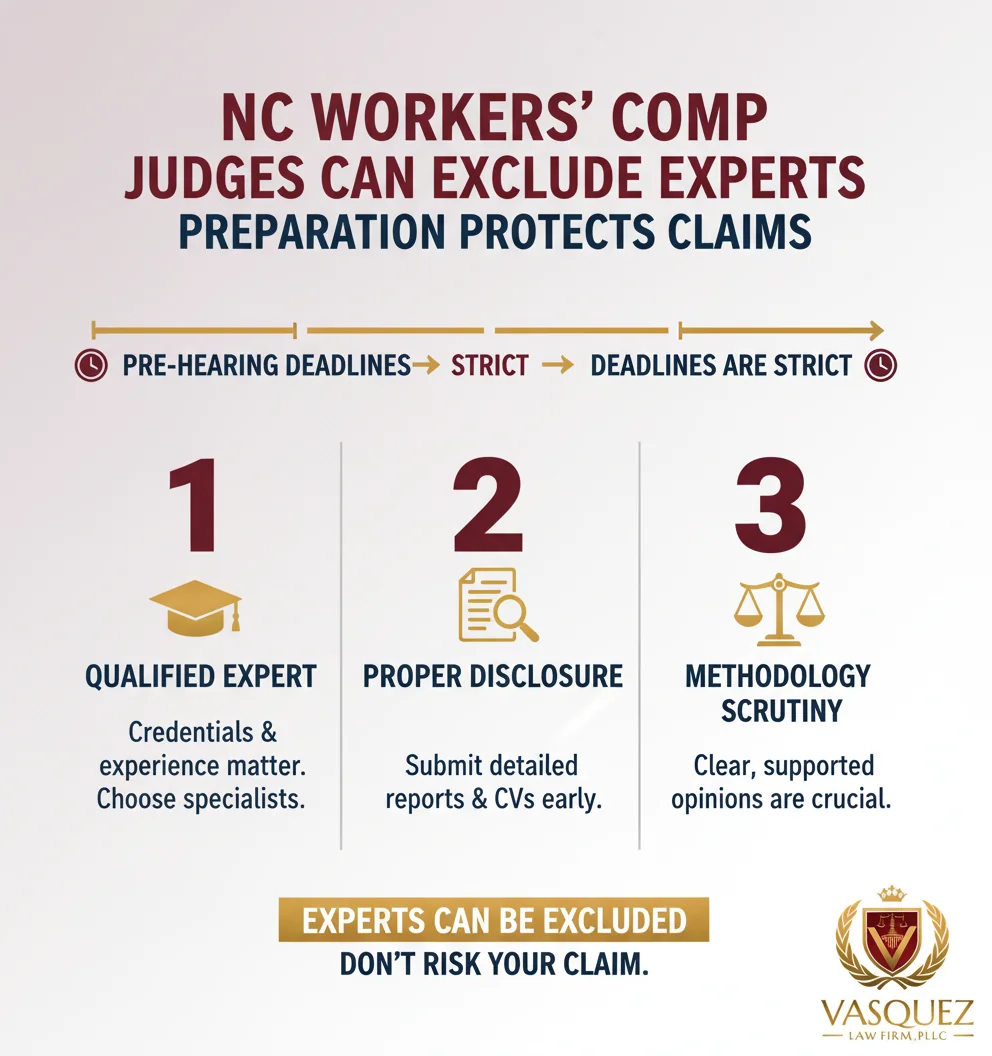
If you’re searching for a workers compensation lawyer NC because your case depends on a doctor, IME, or vocational expert, here’s the twist: a judge may keep that “expert” opinion away from the decision-maker if it’s not reliable. A recent legal news update highlights that judges must screen expert opinions before juries hear them—an issue that can quietly change the outcome of injury and disability disputes.
Quick Summary (Read This First)
What happened: A news report emphasized that judges carry the responsibility to screen expert opinions for reliability before juries consider them.
Why it matters to you: In North Carolina work injury cases, medical and vocational “expert” opinions often decide disability, causation, and benefits—weak opinions can be limited or excluded.
What to do now: Preserve your medical proof, track work restrictions, and identify any “expert” opinion that is unsupported or based on wrong facts.
What This News Means for North Carolina Residents
In a recent article about expert evidence, the key point is simple: judges are not supposed to be passive when experts testify. They must act as gatekeepers and screen expert opinions before juries rely on them. You can read the report here: Judges Carry Onus To Screen Expert Opinions Before Juries.
Why “experts” can decide your workers’ comp outcome
Even though many North Carolina workers’ compensation disputes are handled at the North Carolina Industrial Commission (often through hearings before a Deputy Commissioner rather than a jury), expert-like opinions still matter. Causation and disability frequently rise or fall based on:
- treating physician opinions about work-related causation
- IME opinions (independent medical exam doctors hired by the defense)
- functional capacity evaluations (FCEs)
- vocational assessments about what work you can realistically do
What “screening” means in plain English
Screening means the decision-maker checks whether the opinion is based on solid methods and accurate facts—not guesswork. If an opinion rests on bad assumptions (wrong job duties, missing records, selective history), it can be challenged and given little weight—or in some settings, excluded.
The real-world impact for injured workers in North Carolina
For injured workers, the danger is that an insurer’s hand-picked examiner may issue a confident-sounding opinion that minimizes your injury. If that opinion is not grounded in the records, a strong legal strategy focuses on exposing the gaps. If you’re looking for a workers compensation lawyer NC, this is one of the most important behind-the-scenes battles in contested cases.
What to Do in the Next 24-48 Hours
The earlier you secure your evidence, the harder it is for an insurer to reshape the story later. This is especially true when expert opinions rely on “the history” given to them.
Lock in the facts your doctor will rely on
Many expert disputes are really fact disputes. Your medical providers and evaluators may rely on what’s documented in the first few visits. Make sure the timeline, mechanism of injury, and symptoms are correctly recorded.
Protect your medical proof and restrictions
When work status is disputed, your written restrictions, work notes, and follow-up plans become the backbone of your case.
Avoid common traps that create “bad facts” for experts
If an IME later claims you improved quickly or had “minimal” complaints, it often traces back to inconsistent documentation or gaps in treatment. Address issues early when you can still fix them.
If this situation applies to you, take these steps NOW:
- Step 1: Document everything—write down the date/time of injury, body parts affected, witnesses, and what task you were doing.
- Step 2: Confirm your medical records are accurate—especially the first visit history, diagnosis, and work restrictions.
- Step 3: Do NOT sign broad medical releases or settlement paperwork without understanding how it affects expert opinions and future care.
- Step 4: Consult with a legal expert to understand your rights and options
Warning Signs & Red Flags to Watch For
When expert opinions are in play, the case often turns on subtle pressure tactics and “paper” narratives. Watch for these issues early, because they can shape what an IME doctor or vocational evaluator later claims.
Red flags during IME or specialist referrals
- You’re rushed through an exam that feels more like an interview than a medical evaluation.
- The doctor focuses heavily on old injuries and barely examines the injured body part.
- You’re told your job is “light duty” on paper, but it isn’t in real life.
Red flags in vocational opinions
- A vocational expert lists jobs that don’t fit your restrictions, education, language ability, or transportation limits.
- Job leads are outdated, unrealistic, or far outside your commuting area.
- The report ignores pain medication side effects or flare-ups that affect reliability at work.
Red flags in the “paper trail” insurers build
- Adjusters repeatedly ask the same question, looking for a different answer.
- You’re asked for recorded statements after treatment changes or setbacks.
- You receive surveillance notices or subtle accusations that you’re “fine” because you had one better day.
These are signs your case may be in jeopardy:
- Your employer is pressuring you to return to work before your treating doctor clears you.
- The insurer is relying on a single IME to contradict months of treatment records.
- A vocational report claims you can work, but it ignores real restrictions, pain, or medication side effects.
Seeing these signs? Vasquez Law Firm, PLLC has handled hundreds of denied claims in North Carolina. Attorney Vasquez knows the tactics insurers use. Get a free case evaluation.
Your Rights: What You CAN and CANNOT Do
Workers’ compensation is not just medical care—it’s a rules-based system. Knowing what you can do protects your credibility and prevents insurers from using “noncompliance” as a weapon.
Rights related to medical care and second opinions
In many claims, the insurer controls authorized treatment, but you still have rights to appropriate care and to challenge decisions. If expert opinions become a fight, your treatment history matters more than ever.
Rights related to work status and wages
Disability benefits can depend on restrictions, job offers, and whether work is suitable. Paper job descriptions do not always match real job demands.
Rights related to evidence and hearings
When the insurer leans on questionable expert opinions, the ability to develop evidence—records, testimony, and consistent documentation—can make the difference in a contested hearing.

YOU HAVE THE RIGHT TO:
- Request that your restrictions and work status be clearly documented by your authorized treating provider.
- Challenge an insurer’s denial, termination, or suspension of benefits through the North Carolina Industrial Commission process.
- Have an attorney present for key stages of the claim and to help respond to IME/vocational reports.
YOU CANNOT:
- Assume a “confident” IME report is unbeatable—unreliable opinions can often be exposed through records and cross-examination.
- Ignore deadlines or stop treatment without a plan—gaps are often used to argue you recovered.
Vasquez Law Firm, PLLC helps North Carolina clients understand and protect their rights every day.
Documents You'll Need (Save This Checklist)
When a case turns into an “expert battle,” the winner is often the side with the best records. Don’t rely on someone else to keep them.
Medical documents that matter most in expert disputes
Experts often cite imaging, exam findings, and consistency over time. If something is missing, their opinion may fill the gap in a way that hurts you.
Work and wage documents experts rely on
Vocational opinions can depend on job demands, availability of suitable work, and your wage history.
Communications that can prove pressure or inconsistency
Emails and texts can show what job was offered, what you were told about restrictions, and whether you reported symptoms promptly.
Gather these documents NOW (before they disappear):
- Employer incident report (or any written notice you gave about the injury)
- All medical records, work notes, referrals, imaging reports, and bills
- A symptom journal (pain levels, flare-ups, sleep issues, medication side effects)
- Witness names and contact info (coworkers, supervisors, safety staff)
- Pay stubs and job description documents (including any “light duty” offer details)
Tip: Keep all documents organized in one folder - it makes the process much easier.
KEY TAKEAWAY:
If an insurer’s doctor is building an opinion on the wrong job duties or incomplete records, that is not a “difference of medical opinion”—it’s a reliability problem you can attack with documentation.
Legal Background and Context
Expert screening is not just courtroom drama. It grows out of evidence rules requiring expert opinions to be reliable and properly grounded. In North Carolina, the main evidence rule is Rule 702, which reflects reliability principles commonly associated with “Daubert” analysis. You can read Rule 702 here: N.C. Gen. Stat. § 8C-1, Rule 702.
How North Carolina workers’ comp claims are actually decided
Many workers’ compensation disputes in North Carolina are resolved through the North Carolina Industrial Commission, not a jury trial. That does not make expert reliability less important. It often makes it more important, because written medical opinions, depositions, and vocational reports can carry heavy weight.
For general process and forms, the official resource is the North Carolina Industrial Commission.
Why insurers attack treating doctors—and elevate IMEs
Insurance carriers often argue that treating doctors are “advocates” for patients and that IMEs are more “objective.” In reality, any evaluator can be wrong if they rely on incomplete information. The current news emphasis on judicial gatekeeping underscores a practical point: credentials alone are not enough. The foundation matters.
Key statutes and proof issues in NC work injuries
The Workers’ Compensation Act (Chapter 97) sets the framework for benefits, medical treatment, and disability. Disputes commonly turn on:
- causation: Did work significantly contribute to the condition?
- disability: Are you unable to earn the same wages due to the injury?
- extent of injury: Is it a strain, a tear, a nerve injury, or something chronic?
When these points are contested, expert opinions become the battleground—especially for back injuries, shoulder tears, repetitive trauma, and complex regional pain-type claims.
KEY TAKEAWAY:
In contested cases, it’s not enough to “have a diagnosis.” You need a well-supported explanation linking the diagnosis to work and to your restrictions—because that’s what experts fight over.
How Vasquez Law Firm, PLLC Helps North Carolina Clients Win These Cases
When a case depends on medical or vocational opinions, strategy matters. A workers compensation lawyer NC is not just filing forms; they are building a record that survives scrutiny.
Our approach to expert-driven disputes
Vasquez Law Firm, PLLC focuses on clear documentation, consistent medical proof, and early identification of weak expert assumptions. That includes reviewing the factual basis behind IME conclusions and comparing them to the complete treatment timeline.

Experience and credibility that supports your claim
Attorney Vasquez, JD, has 15 years of experience and is admitted to the North Carolina State Bar and the Florida Bar. Our team also serves Spanish-speaking workers—Se Habla Español—which helps ensure clients can accurately communicate symptoms, restrictions, and work history.
Here’s exactly how we help
Our experienced team, led by Attorney Vasquez, has helped hundreds of North Carolina clients. Here's exactly how we help:
- Step 1: We review the evidence trail (records, restrictions, job duties) to spot where expert opinions may be vulnerable.
- Step 2: We organize the case narrative so doctors and evaluators have accurate facts and timelines.
- Step 3: We challenge insurer tactics, including reports that rely on incomplete history or inconsistent job descriptions.
- Step 4: We pursue the benefits you’re entitled to—medical care and wage replacement—and prepare for hearing if needed.
Real example: "We recently helped a Charlotte construction worker whose claim was denied. Insurance said his injury 'wasn't work-related.' We gathered evidence, fought the denial, and won him $45,000 in benefits plus ongoing medical care." - Attorney Vasquez
If you’re comparing options for a workers compensation lawyer NC, ask whether the firm routinely handles contested cases where expert opinions conflict. That is where preparation shows.

Frequently Asked Questions (Specific to This Situation)
How does this “judge screens experts” news affect IME reports in NC workers’ comp?
It highlights a core issue: not every confident-sounding medical opinion is reliable. In North Carolina workers’ comp disputes, IME opinions can be attacked when they rely on wrong facts (like incorrect job duties), ignore key records, or use conclusions that don’t match exam findings. Even when formal “exclusion” isn’t the mechanism, unreliable opinions can be given less weight when the record shows the weaknesses.
Can a vocational expert’s job list be challenged as unreliable?
Yes. Vocational opinions can be challenged when they assume skills you do not have, ignore restrictions, list jobs that are not realistically available in your area, or rely on outdated labor market data. This is a common flashpoint when the insurer argues you can return to “suitable employment.”
What if the insurer’s expert relied on incomplete medical records?
That can be a major vulnerability. If an expert did not review key imaging, specialist notes, PT notes, or follow-up visits documenting ongoing symptoms, their conclusions may be undermined. A complete timeline often shows whether the opinion is built on a partial snapshot rather than the full course of treatment.
What if the IME report describes my job as “light duty” but it wasn’t?
This is one of the most common “hidden” problems in expert disputes. If the job demands are wrong, then the expert’s conclusions about ability to work may be wrong too. Preserve proof of what you actually did (lifting requirements, repetitive tasks, overtime, tools used, job site conditions). A mismatch between real duties and the report can seriously weaken the insurer’s position.
Does language (English vs. Spanish) affect expert opinions in workers’ comp cases?
It can. If symptoms, history, and limitations are not accurately communicated, the records may unintentionally minimize your condition. Miscommunication can later be used by an insurer’s expert to claim inconsistency. That’s one reason bilingual support matters—especially when your early records are being used as the “foundation” for later opinions.
If my case goes to a hearing at the NC Industrial Commission, will expert reliability still matter?
Yes. Even without a jury, the hearing decision often depends on medical causation opinions, work restrictions, and vocational evidence. Clear documentation, consistent treatment history, and exposing unsupported assumptions are central to how these cases are won or lost in North Carolina.
Don't Navigate This Alone
If you're dealing with a workers’ comp denial or an insurer expert report being used against you, Vasquez Law Firm, PLLC can help. With 15+ years serving North Carolina, we know what works.
Free consultation. Bilingual team. No fees unless we win.
Call Now: 1-844-967-3536
Se Habla Español - Hablamos Su Idioma
Free Legal Consultation
Discuss your case with our experienced attorneys. We're available 24/7.
Vasquez Law Firm
Legal Team
Our experienced attorneys at Vasquez Law Firm have been serving clients in North Carolina and Florida for over 20 years. We specialize in immigration, personal injury, criminal defense, workers compensation, and family law.