Criminal Defense Lawyer NC: WARNING—Crash Drugs = Felony?
Criminal defense lawyer NC explains how a car crash can trigger drug charges, searches, and felony exposure. Learn steps now—Se Habla Español.
Vasquez Law Firm
Published on December 23, 2025
Criminal Defense Lawyer NC: WARNING—Crash Drugs = Felony?
A routine wreck can turn into a drug arrest fast—and many drivers don’t realize how quickly “help at the scene” becomes an investigation. If you’re searching for a criminal defense lawyer NC residents trust, this news story is a clear reminder: what happens in the first minutes after a crash can shape your entire case.
Quick Summary (Read This First)
What happened: Police reportedly arrested a man on drug charges after responding to a car crash.
Why it matters to you: In a crash, officers often expand the stop into a drug investigation—leading to searches, blood draws, and “possession” allegations that can become felonies.
What to do now: Stay calm, don’t guess or volunteer details, and document what officers did and said (including any search requests or testing).
What This News Means for North Carolina Residents
In the reported incident, a crash response reportedly led to a drug arrest, highlighting a pattern many people don’t expect: a traffic collision can become the starting point for a search, questioning, and criminal charges. You can read the report here: source link.
Even though the article involves another state, the “crash-to-charges” pathway is common in North Carolina, too. Officers responding to collisions often must secure the scene, check for injuries, and investigate impairment. That investigation can widen quickly if an officer claims to smell marijuana, sees pills or baggies, or believes a driver is impaired.
Why crashes trigger drug investigations
Crashes create urgency. Police and EMS arrive, vehicles may be towed, and drivers are separated and questioned. That environment makes it easier for misunderstandings—or assumptions—to take hold.
Common “triggers” include:
- Alleged odor of marijuana or alcohol
- Open containers, syringes, pipes, or “baggies” in plain view
- Statements like “I took something earlier” (even if legal or prescribed)
- Injuries requiring hospital care (which can lead to blood testing requests)
“Possession” can be alleged even without drugs in your pocket
In many cases, the charge isn’t based on drugs found on someone’s body. It’s based on where items were found in the car, who had access, and what police believe the driver “knew.” This is where constructive possession arguments often appear.
How this can play out in North Carolina
Serving North Carolina residents, we routinely see cases where a crash is the starting event, but the case turns on search rules, testing procedures, and whether the state can prove “possession” beyond a reasonable doubt. If you’re looking for a criminal defense lawyer NC drivers can rely on after a wreck, focus on counsel who understands both traffic-crash investigations and controlled substance prosecutions.
What to Do in the Next 24-48 Hours
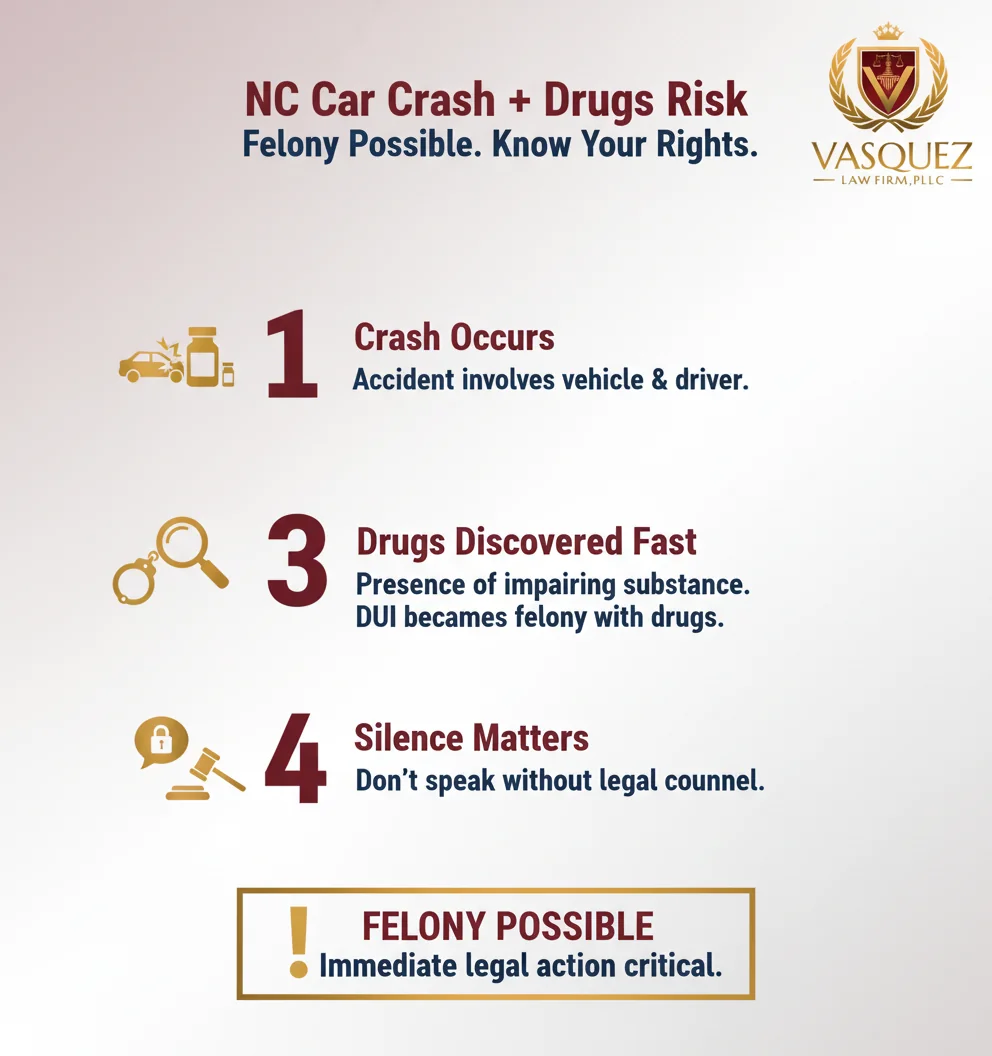
If this situation applies to you, take these steps NOW:
- Step 1: Write a timeline while it’s fresh: where you were, when police arrived, who spoke to you, and any questions asked.
- Step 2: Preserve evidence: photos of the scene, vehicle interior, injuries, prescriptions, tow paperwork, and hospital discharge papers.
- Step 3: Do NOT “explain” by text or social media. Don’t message passengers about what was in the car—those messages can be subpoenaed.
- Step 4: Consult with a legal expert to understand your rights and options
Track what happened during any search
After crashes, searches are often justified as “consent,” “probable cause,” “inventory,” or “search incident to arrest.” Your notes should include whether you were asked for consent, what you said, and whether you were free to leave.
Be careful with medical testing after a crash
If you went to a hospital, document who requested any blood draw and whether a warrant was mentioned. In impaired driving investigations, the steps around chemical testing can matter as much as the result.
Do not miss court or license-related deadlines
Criminal court dates and license consequences can move fast after DWI-related allegations. Keep every notice and envelope, and record the date you received it.
Warning Signs & Red Flags to Watch For
These are signs your case may be in jeopardy:
- Police claim you “agreed” to a search, but you don’t remember clearly (or you were shaken up/injured).
- Officers say drugs were found “near” you (console, door pocket, floorboard), but the car had passengers or recent borrowers.
- You’re told “it’s just a misdemeanor” even though the amount, packaging, or prior history could elevate the charge.
Seeing these signs? Vasquez Law Firm, PLLC has handled hundreds of denied claims in North Carolina. Attorney Vasquez knows the tactics insurers use. Get a free case evaluation.
Why these red flags matter
Crash scenes are chaotic. When the state’s story relies on quick judgments—like “odor,” “furtive movement,” or “admission”—defense strategy often focuses on what can be proven versus what was assumed.
Charges can escalate faster than people expect
A simple possession allegation can grow into possession with intent to sell or deliver (PWISD) if police point to packaging, cash, or quantity. In some cases, paraphernalia and pills can also bring separate counts.

Your Rights: What You CAN and CANNOT Do
YOU HAVE THE RIGHT TO:
- Ask if you are free to leave, and calmly stop answering questions beyond basic identification.
- Refuse consent to search your vehicle (politely and clearly).
- Request a lawyer if you are in custody and being questioned (Miranda rights may apply).
YOU CANNOT:
- Physically interfere with officers, even if you believe a search is unlawful.
- Assume “it’s not mine” ends the case—North Carolina prosecutors may still argue constructive possession.
A defense lawyer can help you assert these rights without making the situation worse.
Consent searches: one word can change the case
When drivers say “sure” or “go ahead,” that can remove major Fourth Amendment arguments later. If you truly want to refuse, say it plainly and then stay calm.
Statements at the scene can become evidence
People often try to be helpful after a wreck. But statements about what you took, when you took it, or who owned what can be used to support possession or impairment theories.
Jail and phone calls are commonly recorded
If you were arrested, assume calls and messages are recorded. Avoid discussing the facts of the case with anyone besides your attorney.
Documents You'll Need (Save This Checklist)
Gather these documents NOW (before they disappear):
- Crash report / incident number (and the responding agency name)
- Tow slip, inventory sheet, and impound paperwork (if your car was towed)
- Hospital/EMS records and discharge papers (especially if blood was drawn)
- Any citations, magistrate’s order, bond paperwork, or conditions of release
- Prescription proof (bottle labels, pharmacy printouts) for any medications involved
Tip: Keep all documents organized in one folder - it makes the process much easier.
KEY TAKEAWAY:
In crash-related drug cases, the strongest defenses often come from details that seem “small”—who had access to the car, whether consent was clear, and whether police followed required procedures during the search and any testing.
Legal Background and Context
To understand why crash scenes often lead to drug charges, it helps to know the legal “building blocks” prosecutors use in North Carolina: (1) a lawful reason to search or seize evidence, and (2) proof that you knowingly possessed a controlled substance.
North Carolina controlled substances law
Most drug possession and PWISD charges are prosecuted under North Carolina’s Controlled Substances Act, including N.C. Gen. Stat. § 90-95 (controlled substances offenses). Whether the case is a misdemeanor or felony depends on the substance, amount, prior record, and other allegations.
Search and seizure rules still apply after a crash
Officers do not get a “free search” simply because there was a collision. The Fourth Amendment and North Carolina constitutional protections generally require a warrant or a valid exception (like consent or probable cause). Courts examine what officers saw, what they smelled, what they asked, and what you allegedly agreed to.
For North Carolina court processes, calendars, and general guidance, see the North Carolina Judicial Branch (NC Courts).
When drug charges overlap with DWI allegations
Crashes often bring impairment questions. In North Carolina, DWI is addressed under N.C. Gen. Stat. § 20-138.1. If police suspect impairment by drugs (not just alcohol), they may rely on observations, field tests, and chemical analysis. How the state collected and handled evidence can be a major issue.
How Vasquez Law Firm, PLLC Helps North Carolina Clients Win These Cases
Crash-based drug cases feel overwhelming because they mix trauma (a wreck) with high-stakes accusations (drugs, impairment, intent to sell). Our experienced team, led by Attorney Vasquez, has helped hundreds of North Carolina clients. With 15 years of experience and bar admissions in the North Carolina State Bar and Florida Bar, he focuses on building a defense plan around the evidence—not assumptions.
How a strong defense is built in practice
Every case is different, but effective defense work commonly involves:
- Step 1: We analyze the stop and crash response for legal issues (consent, probable cause, inventory policy, warrants).
- Step 2: We scrutinize “possession” proof (who owned the car, who had access, where items were found, fingerprints, admissions).
- Step 3: We challenge evidence handling (chain of custody, lab procedures, officer reports vs. body cam).
- Step 4: We develop negotiation and trial strategy based on your goals (dismissal, reduction, diversion, or fighting at trial).
Real example from our practice
Real example: “We represented a client after a wreck where officers claimed they smelled marijuana and searched the vehicle. The state alleged the driver ‘must have known’ about contraband found in a shared area. We obtained video, mapped who had access to the car, and highlighted gaps in the state’s constructive possession theory. The result was a significantly reduced outcome compared to the original charge exposure.” – Attorney Vasquez

Bilingual support matters when the stakes are high
Cases move fast after an arrest. Clear communication can prevent mistakes with court dates, bond conditions, and paperwork. Our team is bilingual—Se Habla Español—so Spanish-speaking clients can understand what’s happening and what’s next.
Frequently Asked Questions (Specific to This Situation)
1) If I crash in North Carolina and police find drugs in the car, is that automatically a felony?
Not automatically. In North Carolina, the charge level depends on the substance and circumstances. Some simple possession charges can be misdemeanors, but many controlled substances (and larger quantities) lead to felony exposure. Packaging, scales, cash, or quantity can push the allegation toward PWISD under N.C. Gen. Stat. § 90-95.
2) Police searched my car after the crash because it was going to be towed. Is that legal?
Sometimes, but not always. Police may claim an “inventory search” before towing. The key issues are whether a tow was lawful, whether the inventory search followed a real written policy, and whether it was done to catalog property (not to hunt for evidence). A criminal defense lawyer NC defendants hire will often request the tow/inventory policy and any body cam footage.
3) I was injured and confused—can police say I consented to a search at the crash scene?
They may claim consent, but valid consent must be voluntary under the totality of the circumstances. Injury, shock, language barriers, and pressure can matter. Video evidence and witness statements can be critical in showing what you actually said (or didn’t say).
4) What if the drugs belonged to my passenger, not me?
That is a common defense issue. Prosecutors may still argue constructive possession if the substance was in an area they claim you controlled (like the driver-side console). The defense often focuses on access, ownership, fingerprints, inconsistent statements, and whether the state can prove knowledge beyond a reasonable doubt.
5) Can a crash investigation turn into a DWI (drug impairment) case even if I wasn’t drinking?
Yes. In North Carolina, DWI can be based on alcohol, drugs, or a combination. After a crash, officers may look for impairment signs and may seek chemical testing. How testing was requested and performed can become a major legal issue.
6) If police took my blood at the hospital after the crash, can I challenge it?
Possibly. Challenges can involve warrants, consent, timing, chain of custody, lab methods, and whether the test is being used correctly to prove impairment. Your medical records and the warrant paperwork (if any) are key documents to gather.
7) I live in North Carolina but the crash happened out of state—should I still talk to an NC lawyer?
Yes, especially if you have a North Carolina driver’s license or any NC case or probation status that could be affected. A criminal defense lawyer NC clients trust can help you understand collateral consequences at home (license, employment, immigration concerns) and coordinate with counsel in the other state if needed.
Don't Navigate This Alone
If you're dealing with crash-related drug charges or an investigation after a wreck, Vasquez Law Firm, PLLC can help. With 15+ years serving North Carolina, we know what works.
Free consultation. Bilingual team. No fees unless we win.
Call Now: 1-844-967-3536
Se Habla Español - Hablamos Su Idioma
Free Legal Consultation
Discuss your case with our experienced attorneys. We're available 24/7.
Vasquez Law Firm
Legal Team
Our experienced attorneys at Vasquez Law Firm have been serving clients in North Carolina and Florida for over 20 years. We specialize in immigration, personal injury, criminal defense, workers compensation, and family law.