Immigration lawyer: WARNING—H-1B Visa Chaos Strands Travelers
Immigration lawyer insight on H-1B visa chaos: avoid reentry traps, 221(g) delays, and job loss risks. Get help now—call 1-844-967-3536.
Vasquez Law Firm
Published on December 22, 2025

Immigration lawyer: WARNING—H-1B Visa Chaos Strands Travelers
If you’re an H-1B professional (or your spouse/children) living in North Carolina, the latest reports of visa chaos and policy shifts are a real-world warning: one “routine” trip abroad can turn into weeks of being stuck outside the U.S. An experienced immigration lawyer can help you spot the hidden risks before you travel—and help you recover fast if you’re already stranded.
Quick Summary (Read This First)
What happened: News reports describe Indian H-1B visa holders getting stranded abroad as U.S. visa processing and policy changes create delays and uncertainty.
Why it matters to you: North Carolina residents working on H-1B (and families on H-4) can lose pay, risk job status, and face reentry problems if a visa stamp is delayed or refused.
What to do now: Pause non-essential travel, verify your documents and employer support, and make a written contingency plan for visa delays before you leave the U.S.
What This News Means for North Carolina Residents
Recent coverage highlights “visa chaos” affecting Indian H-1B holders who traveled and then could not return on the timeline they expected. The report describes travelers facing shifting requirements, long processing times, and uncertainty at consulates, leading to people being stuck outside the U.S. (see source link).
Why this hits North Carolina harder than people expect
North Carolina has a large community of global professionals in tech, healthcare, higher education, and research. Many work in the Research Triangle (Raleigh, Durham, and Chapel Hill) or in Charlotte’s banking and fintech sector.
That means many families in North Carolina have a common “life pattern”: visit family abroad, attend a wedding, or handle emergencies—then return to jobs, leases, and school schedules. When consular processing slows down, everything can break at once.
What “stranded” can mean in real life
In H-1B cases, being stuck outside the U.S. can trigger practical and legal problems at the same time. Examples include:
- Missing a return flight because the passport is held for visa issuance or additional review
- A visa application being refused temporarily under “administrative processing” (often referred to as 221(g))
- An employer questioning whether you can keep your role or meet project deadlines
- H-4 spouse/children missing school start dates or medical appointments
A key point: travel affects your visa stamp, not your H-1B status inside the U.S.
Many people confuse “status” with a “visa.” Your H-1B status is what allows you to work and remain in the U.S. while you are here. Your H-1B visa stamp is what you generally need to re-enter after travel abroad.
This is where an immigration lawyer can add value: the strategy is often less about “Can I travel?” and more about “What is the safest way to re-enter, and what’s our backup plan if the consulate delays the stamp?”
What to Do in the Next 24-48 Hours
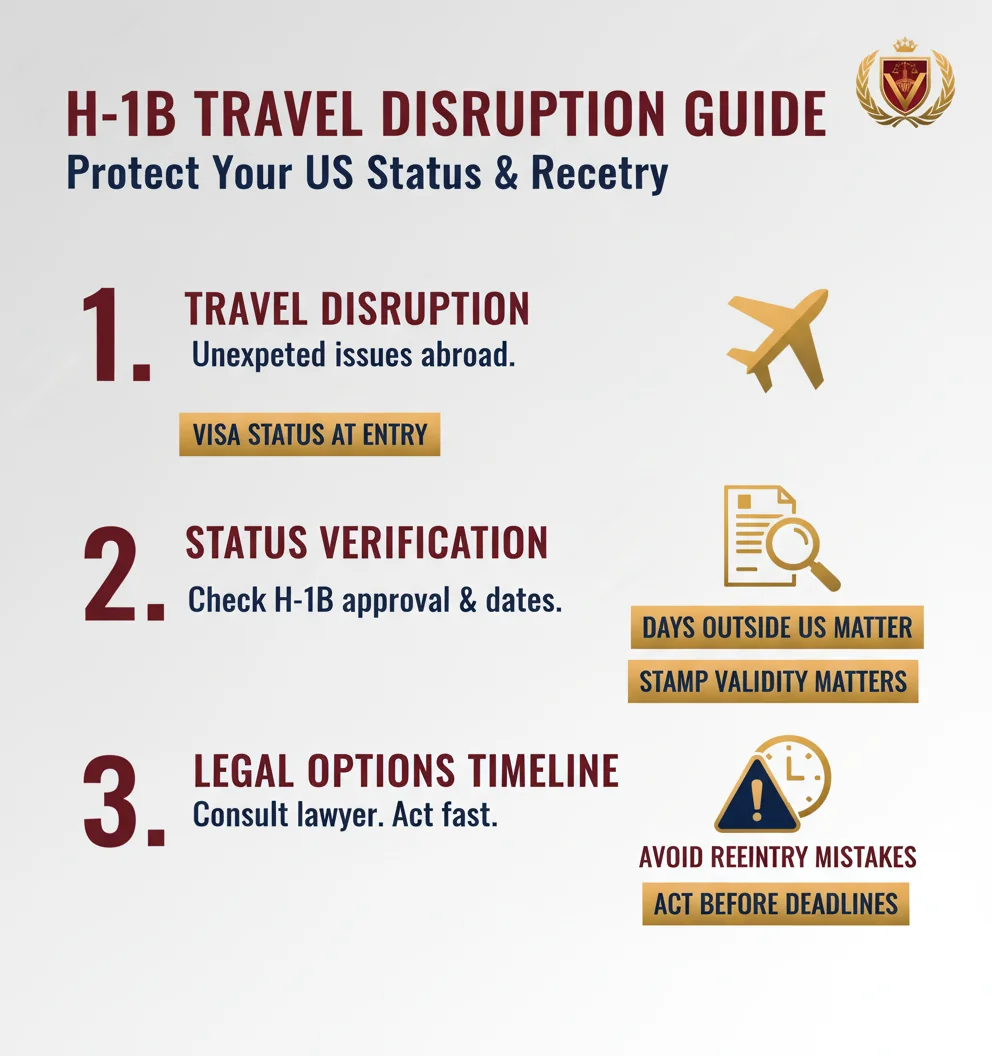
1) Stop and triage your travel risk
If you have upcoming international travel, take a hard look at timing, consulate backlogs, and your job’s flexibility. If you are already abroad, the next 48 hours are about stabilizing: documents, employer communication, and proof that you remain eligible.
2) Build your “reentry proof” file
Start collecting the documents that show your job is real, your role matches the petition, and your employer is continuing the employment under the approved terms.
If this situation applies to you, take these steps NOW:
- Step 1: Document everything—save emails from the consulate, appointment confirmations, DS-160/receipt pages, and a timeline of travel and work dates.
- Step 2: Notify your employer in writing that your return depends on visa issuance; ask for a letter confirming continued employment, work location, and job duties.
- Step 3: Do NOT guess or “wing it” at the interview—review your petition details (title, duties, salary, worksite) so your answers match the filed case.
- Step 4: Consult with a legal expert to understand your rights and options
If you are already stuck abroad
Prioritize these decisions quickly: whether to reschedule flights, whether your employer can support remote work, and whether a dependent needs separate processing. If an application is placed in additional review, your next steps depend heavily on the specific reason given and the documents requested.
Warning Signs & Red Flags to Watch For
Red flags at the consulate or in your case file
In many “visa chaos” stories, the person did nothing wrong—they simply hit a processing bottleneck. Still, some warning signs predict longer delays or a higher risk of refusal.
These are signs your case may be in jeopardy:
- Your case is marked for “administrative processing” (often called 221(g)) and the consulate keeps your passport without a clear timeline.
- Your job title, duties, salary, or work location changed since the last H-1B approval and you’re not sure an amended petition was filed.
- You are asked for extra proof of specialty occupation, employer-employee relationship, end-client letters, or worksite details.
Seeing these signs? Vasquez Law Firm, PLLC has handled hundreds of denied claims in North Carolina. Attorney Vasquez knows the tactics insurers use. Get a free case evaluation.
Red flags on the employer side
- Employer can’t quickly provide an updated verification letter or pay statements
- Confusion about whether you’re working at a client site, hybrid, or remote
- Recent layoffs, merger, acquisition, or major restructure affecting your role
Red flags for families (H-4 and children)
- Dependent visa appointments are scheduled far later than the principal’s
- A child is close to “aging out” and timing is critical
- Prior overstay, prior visa refusal, or status violation in the family history
Your Rights: What You CAN and CANNOT Do
What you can do to protect yourself during uncertainty
Visa processing can feel arbitrary, but you still have clear rights and smart options—especially if you keep your paperwork consistent and truthful.

YOU HAVE THE RIGHT TO:
- Ask what document(s) are missing and submit requested evidence through the consulate’s stated process.
- Refuse to guess or exaggerate—your best protection is accurate, consistent answers that match the petition and your records.
- Request help from your employer (letters, project proof, payroll records) to show the role is real and ongoing.
YOU CANNOT:
- Assume a prior approval guarantees a new visa stamp—consular officers can re-review eligibility at each application.
- Hide prior issues (visa refusals, arrests/charges, prior overstays, or job changes)—inconsistencies can trigger denial or long delays.
Vasquez Law Firm, PLLC helps North Carolina clients understand and protect their rights every day.
What happens at the airport (CBP) vs. at the consulate
Even with a valid visa stamp, U.S. Customs and Border Protection (CBP) makes the final admission decision at entry. Keep your core documents in your carry-on. If you land at Charlotte Douglas International Airport or Raleigh-Durham International Airport, be prepared for standard questions about your job, employer, and worksite.
Special note for H-4 dependents
H-4 dependents are tied to the principal H-1B in many ways, but they can face separate delays or document requests. Coordinate appointment timing and keep copies of the principal’s approval notice and employment proof.
Documents You'll Need (Save This Checklist)
Core documents for H-1B stamping/reentry
Gather these documents NOW (before they disappear):
- Current and prior passports (and copies of biographic/visa pages)
- H-1B approval notice (Form I-797) and, if available, the full petition support letter
- Recent pay stubs (commonly last 2–3 months) and W-2s/tax documents if available
- Employer verification letter stating title, duties, salary, and work location(s)
- Degree(s), transcripts, and credential evaluations (if used in the case)
Tip: Keep all documents organized in one folder - it makes the process much easier.
Worksite and end-client documents (often requested)
- Client letters confirming assignment, location, and duties (if you work at a client site)
- Statements of work (SOW), work orders, or project documentation
- Organizational chart, manager contact, and brief project summary
Documents for H-4 family members
- Marriage certificate (with certified translation if not in English)
- Birth certificates for children
- Copies of the principal’s I-797 approval and employment proof
KEY TAKEAWAY:
Most “stranded abroad” crises start with a simple gap: people travel with a valid I-797, but they underestimate how a delayed visa stamp can stop them from re-entering—no matter how stable their job is in North Carolina.
Legal Background and Context
The legal framework behind H-1B travel and visa stamping
H-1B employment is governed by federal immigration law and regulations, including statutory authority at 8 U.S.C. § 1184 and regulatory rules in 8 C.F.R. § 214.2(h). These rules address who qualifies, how petitions are filed, and how status works inside the U.S.
But visa stamps are handled through the U.S. Department of State’s consular process abroad. The Department of State’s visa information resources are published at travel.state.gov (U.S. visas).
Why consular processing can slow down suddenly
Consulates may increase security screening, request additional documents, or conduct “administrative processing.” This can happen due to policy updates, workload, technology issues, or risk screening protocols. Even when your employer’s petition was approved by USCIS, consular officers can still ask questions and request proof before issuing a visa stamp.
For official benefit and filing information, USCIS publishes current guidance at uscis.gov.
If problems escalate: immigration court and removal context
Most H-1B travel delays never reach immigration court. But if a case involves status violations, prior removal issues, or complicated inadmissibility concerns, understanding the immigration court system matters. The Executive Office for Immigration Review (EOIR) provides official information at justice.gov/eoir.
How Vasquez Law Firm, PLLC Helps North Carolina Clients Win These Cases
The goal: prevent travel disasters and fix them fast when they happen
Travel-based H-1B problems are time-sensitive. The right plan can reduce the risk of a delay and can also shorten the time you spend stuck abroad if something goes wrong.
What our team does in H-1B visa-chaos cases
Our experienced team, led by Attorney Vasquez, has helped hundreds of North Carolina clients. Here's exactly how we help:
- Step 1: We review your case for free and tell you honestly if you have a claim
- Step 2: We handle all paperwork and deadlines so nothing gets missed
- Step 3: We fight insurance tactics - we know their playbook
- Step 4: We maximize your settlement or take it to hearing if needed
Real example (what this looks like in practice)
Real example: “We helped an H-1B professional working in the Raleigh-Durham area whose visa stamping was delayed abroad after a job-location change. We coordinated with the employer to confirm the correct worksite details, organized payroll and project evidence, and prepared a clean, consistent document packet. The visa was issued after additional review, and the client returned to North Carolina without losing the role.” - Attorney Vasquez
Vasquez Law Firm, PLLC also advises clients on travel readiness, petition consistency, and risk flags before they leave the U.S. You can learn more about our Immigration Law services.


Frequently Asked Questions (Specific to This Situation)
Can I travel from North Carolina on H-1B if my visa stamp is expired but my I-797 is valid?
Yes, you can depart the U.S. with an expired visa stamp. The problem is reentry: in most cases you must obtain a new visa stamp at a U.S. consulate abroad before returning. The current “visa chaos” risk is that stamping may take longer than expected due to extra screening or processing delays, leaving you stuck outside the U.S.
If my H-1B stamping is put in 221(g) administrative processing, what should I do first?
First, get clarity on what the consulate is requesting and how you must submit it (each post has rules). Next, gather objective proof that your job and petition details are consistent: employer letter, pay stubs, approved I-797, and (if relevant) end-client/project documents. Finally, keep a written timeline and copies of every submission. An immigration lawyer can help you avoid sending incomplete or inconsistent evidence that triggers more delay.
I work hybrid in Charlotte, but my H-1B petition lists a different location. Can that cause a visa delay?
It can. Worksite details matter in H-1B cases, especially where the job is performed and whether the petition and Labor Condition Application (LCA) match reality. If your day-to-day location changed, you may need an amended filing depending on the facts. If a consulate sees mismatched addresses, it may request more documents or delay issuance.
My employer wants me to work remotely while I’m stuck abroad. Does that “fix” my U.S. immigration problem?
Remote work may help you keep your job duties moving, but it does not automatically solve the immigration issue of reentry and visa issuance. Also, working from abroad can raise tax, payroll, and local labor law issues in the country you are in. For U.S. immigration purposes, the urgent question remains: what documentation will satisfy the consulate so you can be issued a visa and return to North Carolina.
Do H-4 spouses and kids get delayed too, even if the H-1B is approved quickly?
Yes. Dependents can have separate appointments, separate administrative processing, and separate document requests. If a family member’s case is delayed, the family may have to decide whether the principal returns first or waits. Planning appointment timing and carrying duplicate copies of the H-1B approval and employment documents can reduce problems.
If I have a pending green card process, does this visa chaos affect travel?
It might. Some people have both an H-1B and a pending permanent residence strategy (for example, an approved I-140 or a pending I-485). Each situation changes travel options and risk. For example, if you rely on advance parole, you must plan carefully before leaving; if you rely on H-1B reentry, visa stamping delays can still trap you abroad. An immigration lawyer can help map the safest travel method for your specific stage.
Does it matter if my job is in Wake County vs. Mecklenburg County for federal H-1B issues?
H-1B law is federal, so the county does not change the core rules. But your worksite location in North Carolina can matter because LCAs and petitions are tied to geographic areas and commuting patterns. A move from Raleigh (Wake County) to Charlotte (Mecklenburg County), or a long-term client assignment change, can create documentation and compliance issues that show up during stamping.
Don't Navigate This Alone
If you're dealing with H-1B visa stamping delays, travel reentry problems, or being stranded abroad due to shifting visa policies, Vasquez Law Firm, PLLC can help. With 15+ years serving North Carolina, we know what works.
Free consultation. Bilingual team. No fees unless we win.
Call Now: 1-844-967-3536
Se Habla Español - Hablamos Su Idioma
Free Legal Consultation
Discuss your case with our experienced attorneys. We're available 24/7.
Vasquez Law Firm
Legal Team
Our experienced attorneys at Vasquez Law Firm have been serving clients in North Carolina and Florida for over 20 years. We specialize in immigration, personal injury, criminal defense, workers compensation, and family law.