workers compensation lawyer NC: Supreme Court STOPPED Union Order
workers compensation lawyer NC explains why the Supreme Court halt matters for worker rights, delays, and benefits. Learn next steps—request a free consult.
Vasquez Law Firm
Published on December 23, 2025

workers compensation lawyer NC: Supreme Court STOPPED Union Order
When the U.S. Supreme Court halts a worker-related order, it sends a clear message: even “wins” can be paused, delayed, or narrowed on appeal. If you’re dealing with a work injury claim, that same reality shows up in workers’ comp—benefits can be challenged, payments can stall, and paperwork can become the battleground. This post explains what the recent Supreme Court move means, and how a workers compensation lawyer NC looks at delays, leverage, and next steps for injured workers in North Carolina.
Quick Summary (Read This First)
What happened: The U.S. Supreme Court halted (paused) an order tied to the Pittsburgh Post-Gazette and a union-related dispute.
Why it matters to you: A “halt” is a reminder that legal rights can be delayed while appeals play out—similar to how workers’ comp insurers may dispute, appeal, or slow-walk benefits.
What to do now: Protect your claim like it could be challenged: report the injury, get medical care, document work restrictions, and track every insurer/employer communication.
What This News Means for North Carolina Residents
According to reporting on Law360, the U.S. Supreme Court halted an order involving the Pittsburgh Post-Gazette and a union-related dispute. You can read the coverage here: Supreme Court halts Pittsburgh Post-Gazette union order.
Why a Supreme Court “halt” matters (even if you’re not in a union)
A halt (often called a “stay”) can pause enforcement of a lower decision while higher courts review it. For workers, this has a practical takeaway: a legal victory can still be put on hold.
In everyday injury claims, a similar pattern happens when an employer or insurer:
- disputes that your injury is work-related,
- argues you can return to work sooner than your doctor says, or
- claims you missed a deadline or did not follow a rule.
The workers’ comp parallel: delays are a strategy
Workers’ compensation is supposed to be “no-fault,” but that does not mean “no fight.” When a case turns into a paperwork contest, delay can pressure injured workers to give up or accept less.
That’s why many people start searching for a workers compensation lawyer NC when checks stop, medical appointments get denied, or the insurer starts asking for repeated “proof.”
What this means locally in North Carolina
In North Carolina, workers’ compensation disputes run through the North Carolina Industrial Commission (often called the “NCIC”). Knowing the process—and how insurers build defenses—can make the difference between getting care quickly and getting stuck in delays.
What to Do in the Next 24-48 Hours
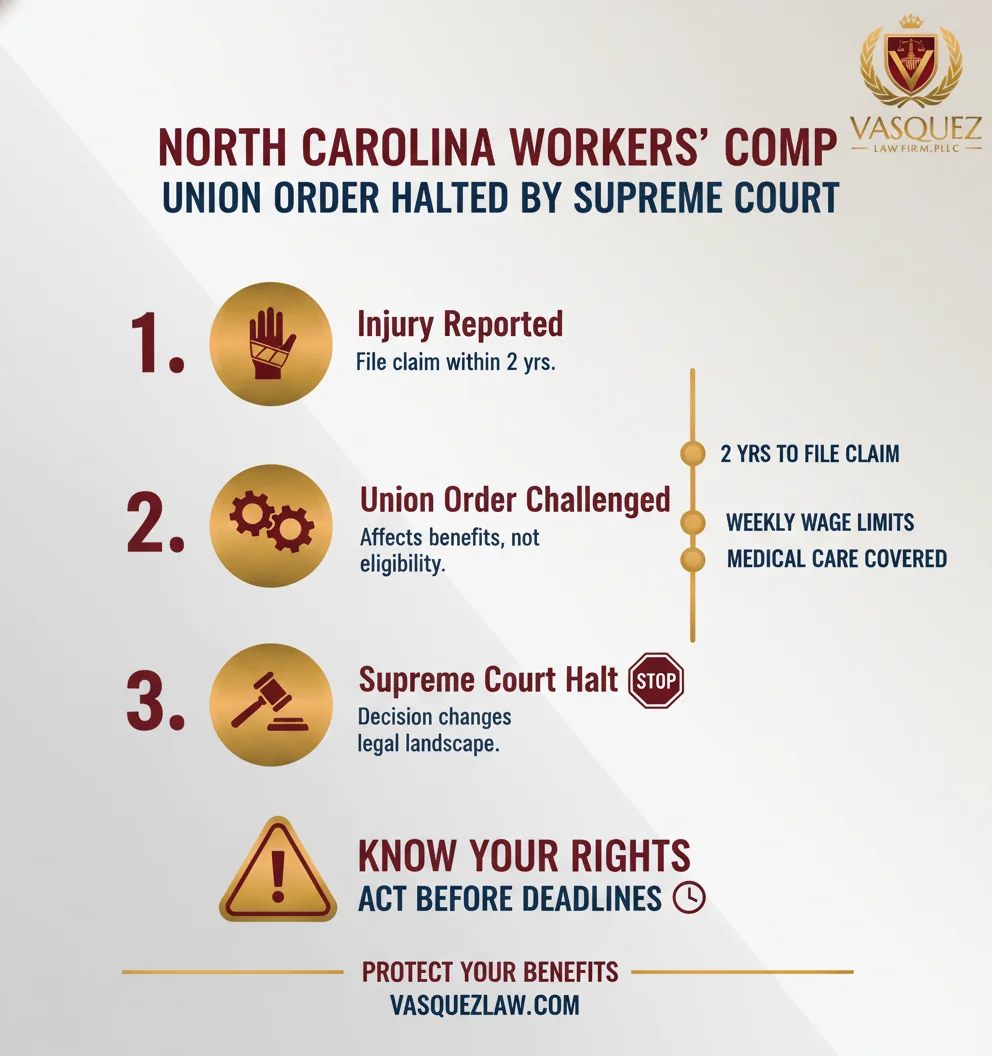
Your goal: lock in proof before the story changes
After a work injury (or after benefits are questioned), the first 24–48 hours are when details are freshest and documents are easiest to secure. Treat it like the claim will be challenged later.
If this situation applies to you, take these steps NOW:
- Step 1: Document everything—photos, job site conditions, equipment, visible injuries, and a timeline (who, what, where, when).
- Step 2: Report the injury to your supervisor/HR in writing and keep a copy. In many cases, delay becomes the insurer’s favorite argument.
- Step 3: Get medical care and clearly describe how the injury happened at work; ask the provider to note work restrictions in writing.
- Step 4: Consult with a legal expert to understand your rights and options
If checks or treatment already stopped
If you were already receiving benefits and something changed, write down exactly when it changed and what you were told. Save letters, claim notes, portal screenshots, and voicemail messages.
Avoid these common early mistakes
- Assuming a verbal report is “enough” (later, it can become “we never got notice”).
- Downplaying pain at the first visit (“it’s fine”) and later trying to correct the record.
- Returning to full duty without written clearance and then re-injuring yourself.
Warning Signs & Red Flags to Watch For
Red flags that usually signal a denial or delay is coming
Just like the Supreme Court’s halt shows how quickly a result can change, workers’ comp cases can shift when the insurer decides to fight.
These are signs your case may be in jeopardy:
- Your employer is pressuring you to return to work before your doctor clears you (or before restrictions are respected).
- The insurance adjuster is delaying wage checks, canceling appointments, or saying “we’re still investigating” weeks later.
- You’re being told you “don’t qualify” because it was a pre-existing condition, you didn’t report “right away,” or there were no witnesses.
Seeing these signs? Vasquez Law Firm, PLLC has handled hundreds of denied claims in North Carolina. Attorney Vasquez knows the tactics insurers use. Get a free case evaluation.
Why insurers push recorded statements early
A recorded statement can lock you into wording you regret later. Even honest workers can get trapped by “yes/no” questions that skip important details (like how pain started, how long symptoms lasted, or what your job requires).
The quiet retaliation problem
Not all retaliation looks like being fired. It can look like a sudden schedule change, fewer hours, being moved to harsher work, or being written up for small issues right after an injury report. Keep a written log of changes after your claim begins.
Your Rights: What You CAN and CANNOT Do
Rights that come up most in North Carolina workers’ comp disputes
Workers’ comp is rule-heavy. A workers compensation lawyer NC often helps by making sure you use the rules to protect your benefits—not the other way around.

YOU HAVE THE RIGHT TO:
- Report a work injury and seek benefits even if no one saw it happen (many injuries develop over a shift or over time).
- Receive authorized medical treatment reasonably required to “effect a cure” or provide relief (a core concept under NC workers’ comp law).
- Challenge denials and request a hearing at the North Carolina Industrial Commission if the insurer refuses benefits.
YOU CANNOT:
- Assume your employer will “handle it” without you tracking deadlines, forms, and medical restrictions.
- Miss required notice and filing deadlines—late notice and late filings are common reasons insurers raise to dispute claims.
Vasquez Law Firm, PLLC helps North Carolina clients understand and protect their rights every day.
Modified duty vs. your doctor’s restrictions
If you’re offered “light duty,” compare it to your written restrictions. If the job exceeds those restrictions, it can risk your health and create arguments later about whether you refused suitable work.
Appeals and “pauses” in comp cases
The Supreme Court story highlights a key idea: decisions can be paused while higher review happens. In workers’ comp, disputes can also create delays—especially when there’s disagreement about causation, disability status, or the right treatment plan.
Documents You'll Need (Save This Checklist)
Build a paper trail that’s hard to argue with
If a claim turns into a dispute, documents often matter more than memories. Save copies on your personal device or a folder you control.
Gather these documents NOW (before they disappear):
- Any written injury report, email, or text message notifying a supervisor/HR.
- All medical records, work notes, restrictions, referrals, and bills (even if “workers’ comp will pay”).
- Photos/video of the scene, equipment, hazard, or visible injury (with dates if possible).
- Witness names and contact information (coworkers, foreman, safety lead).
- Pay stubs (to prove average weekly wage and lost time) and a list of missed days/hours.
Tip: Keep all documents organized in one folder - it makes the process much easier.
If you’re in a union workplace
If the news made you wonder about union-related protections, keep any collective bargaining agreement sections that relate to injury reporting, job bids, modified duty, and discipline. Workers’ comp is separate, but workplace rules can affect the timeline and communication trail.
KEY TAKEAWAY:
In North Carolina, late notice and missing paperwork are two of the easiest ways for an insurer to dispute a claim. Act fast, document early, and keep copies.
Legal Background and Context
Who runs workers’ comp in North Carolina?
Workers’ compensation claims are administered through the North Carolina Industrial Commission (NCIC), which sets rules, forms, and procedures for disputes. The NCIC also handles hearings when claims are denied or benefits are cut off.
Key North Carolina workers’ comp statutes you should know
Most workers’ comp rights and duties in North Carolina come from Chapter 97 of the North Carolina General Statutes. Common sections involved in disputes include:
- N.C. Gen. Stat. § 97-22 (notice of accident to the employer): insurers often argue notice was not timely or not clear.
- N.C. Gen. Stat. § 97-24 (time limits for filing claims): missing a filing deadline can be devastating.
- N.C. Gen. Stat. § 97-25 (medical compensation): disputes arise over “authorized” care, referrals, and whether treatment is necessary.
- N.C. Gen. Stat. § 97-29 (temporary total disability): wage benefits depend on disability status and work ability.
- N.C. Gen. Stat. § 97-30 (partial disability): issues arise when you return with restrictions and earn less.
You can review North Carolina statutes on the official legislature site (for example, Chapter 97): North Carolina General Statutes, Chapter 97.
How legal delays hurt injured workers (and why that matters)
The Supreme Court halt in the Post-Gazette matter is a reminder that legal process can be slow—even when the issue is urgent for workers. In workers’ comp, delays can mean:
- missed rent or mortgage payments,
- gaps in treatment (which can worsen injuries), and
- pressure to accept a low settlement just to move forward.
This is one reason people look for a workers compensation lawyer NC early: not to “fight for the sake of fighting,” but to reduce avoidable delays and keep the case moving on the correct track.
How Vasquez Law Firm, PLLC Helps North Carolina Clients Win These Cases
Our approach: treat every file like it could be appealed
Legal news like a Supreme Court halt shows how fast a case can change when higher review gets involved. Our team builds claims with the expectation that the insurer may challenge causation, disability, or treatment later.
What we do step-by-step
Our experienced team, led by Attorney Vasquez, has helped hundreds of North Carolina clients. Here's exactly how we help:
- Step 1: We review your case for free and tell you honestly if you have a claim
- Step 2: We handle all paperwork and deadlines so nothing gets missed
- Step 3: We fight insurance tactics - we know their playbook
- Step 4: We maximize your settlement or take it to hearing if needed
Real example (what “winning” can look like)
Real example: "We recently helped a Charlotte construction worker whose claim was denied. Insurance said his injury 'wasn't work-related.' We gathered evidence, fought the denial, and won him $45,000 in benefits plus ongoing medical care." - Attorney Vasquez

Attorney Vasquez (JD) has 15 years of experience and is admitted to the North Carolina State Bar and the Florida Bar. Our team is bilingual—Se Habla Español. For more on our focus area, see our Workers Compensation services page.
Frequently Asked Questions (Specific to This Situation)
Why does a Supreme Court “halt” matter to a workers’ comp claim?
Because it highlights how quickly enforcement can be paused while a higher authority reviews the dispute. In workers’ comp, insurers use disputes, hearings, and procedural rules to slow down benefits—especially when the medical issues are complex.
If my workplace is unionized, does this news change my NC workers’ comp rights?
Your core workers’ comp rights come from North Carolina workers’ comp law, not the union contract. But union rules may affect job assignments, discipline, and communications—which can affect evidence and timelines in a contested claim.
Can an insurer “pause” my checks the way courts can pause an order?
Insurers can stop or deny wage benefits if they claim you’re no longer disabled, you refused suitable work, or the injury is not compensable. If that happens, the dispute typically moves through NCIC procedures. Documentation from doctors and a consistent paper trail become critical.
The adjuster asked for a recorded statement after I read this news—should I be worried?
It’s a common tactic. The risk is not that you’re “lying,” but that the recording captures incomplete details that later get used against you (like uncertain timelines or casual phrases such as “I guess it started at home”). Keep your facts consistent with medical records and written reports.
If my employer changes my schedule after I report an injury, is that a red flag?
Yes. Not every change is illegal retaliation, but a sudden pattern right after an injury report is important evidence. Keep a dated log of schedule changes, write-ups, and job duty changes, and save texts/emails.
Where will my dispute be handled in North Carolina?
Most contested workers’ comp issues are handled through the North Carolina Industrial Commission. If you’re serving North Carolina residents across multiple counties (like Mecklenburg, Wake, Guilford, or Cumberland), the same statewide system applies, but local medical providers and employer practices can change how evidence is gathered.
If I already signed paperwork, can I undo it because benefits got delayed?
It depends on what you signed and whether it was approved through the proper process. Some agreements are final once approved; others may be challenged in narrow circumstances. The safest move is to pause before signing anything and make sure you understand the long-term medical and wage impact.
Don't Navigate This Alone
If you're dealing with a denied, delayed, or disputed North Carolina workers’ compensation claim, Vasquez Law Firm, PLLC can help. With 15+ years serving North Carolina, we know what works.
Free consultation. Bilingual team. No fees unless we win.
Call Now: 1-844-967-3536
Se Habla Español - Hablamos Su Idioma
Free Legal Consultation
Discuss your case with our experienced attorneys. We're available 24/7.
Vasquez Law Firm
Legal Team
Our experienced attorneys at Vasquez Law Firm have been serving clients in North Carolina and Florida for over 20 years. We specialize in immigration, personal injury, criminal defense, workers compensation, and family law.