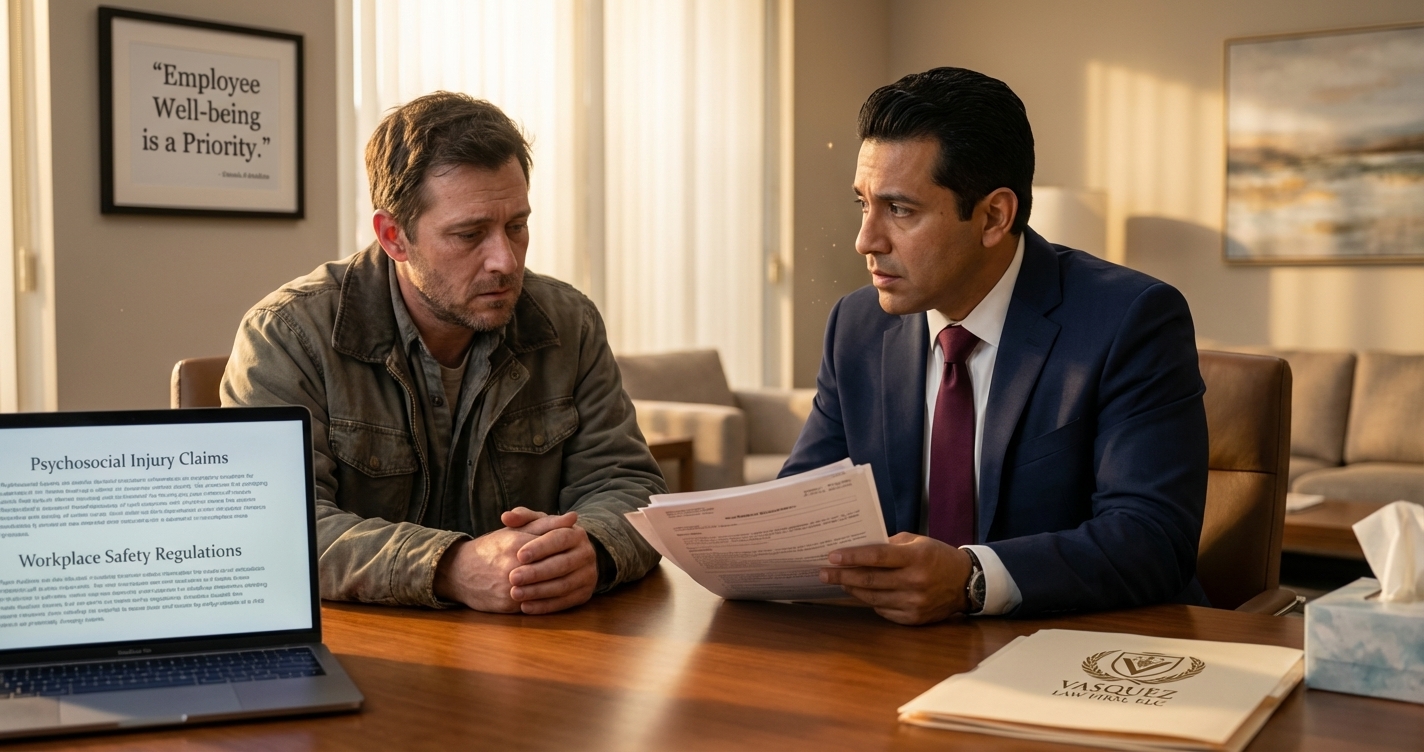
workers compensation lawyer NC: WARNING—Michigan 2025 rulings
workers compensation lawyer NC explains what Michigan’s 2025 court rulings may signal for denied claims, IMEs, and settlements in North Carolina.
Vasquez Law Firm
Published on December 22, 2025
workers compensation lawyer NC: WARNING—Michigan 2025 rulings
If you were hurt at work and your claim suddenly feels harder than it should, you’re not imagining it. A recent roundup of Michigan’s biggest employment court rulings of 2025 is a reminder that courts are tightening rules around proof, benefits, and employer defenses—and insurers often try to import those strategies everywhere. This post explains what a workers compensation lawyer NC looks for when these “trend” decisions start shaping how claims get handled in real life.
Quick Summary (Read This First)
What happened: A legal news roundup highlighted Michigan’s 5 biggest court rulings of 2025, reflecting how courts are addressing work, injury, and employment-dispute issues.
Why it matters to you: Even though Michigan rulings don’t control North Carolina cases, insurers and employers often copy winning arguments, which can lead to more denials, tighter medical reviews, and tougher settlement positions.
What to do now: Lock down documentation, follow authorized medical treatment, and watch for delay tactics—especially if your employer operates in multiple states.
What This News Means for North Carolina Residents
Legal trends don’t stay in one state. When large employers and insurance carriers see arguments working in court, they test the same playbook elsewhere—even when the law is different. That’s why this roundup of Michigan’s 5 biggest court rulings of 2025 (Law360) matters to injured workers who are filing—or already fighting—a claim.
1) Michigan isn’t “the law” here—but it can shape tactics
Michigan decisions are not binding on the North Carolina Industrial Commission. But insurance adjusters, defense lawyers, and big employers often take ideas from other states and try them in negotiations, recorded statements, and hearings. A workers compensation lawyer NC can spot when an argument sounds persuasive but doesn’t actually match North Carolina statutes or Commission rules.
2) Multi-state employers often standardize claim handling
If your employer has locations in several states, your claim may be managed by a centralized risk department or a national carrier. That can mean one “company approach” to surveillance, return-to-work pressure, and disputing medical causation—regardless of where you got hurt.
3) Why 2025 rulings can affect 2026 claim behavior
Courts don’t just decide cases; they send signals. When courts tighten standards on evidence or allow certain defenses, claim departments adjust. That can show up as more independent medical exams (IMEs), more requests for recorded statements, and more disputes over whether the injury is work-related.
What to Do in the Next 24-48 Hours

If you were injured at work (or your benefits were cut off), the next day or two can decide whether your claim is smooth—or becomes a fight. North Carolina deadlines and documentation rules can be unforgiving.
Document your injury like you’re proving it to a stranger
Assume that, later, someone will question whether the accident happened the way you said it did. Write it down while it’s fresh.
Get the right medical paper trail started
Benefits often turn on medical records: objective findings, clear work restrictions, and consistent history. Gaps in treatment can be used against you.
Be careful with HR forms and “friendly” check-ins
Employers may request statements or forms that seem routine but can be used to dispute your claim later. Keep copies of anything you submit.
If this situation applies to you, take these steps NOW:
- Step 1: Document everything—photos, names, shift schedule, the exact time/place, and what task you were doing when you felt pain or got hurt.
- Step 2: Report the injury in writing as soon as possible (North Carolina generally expects notice within 30 days under N.C. Gen. Stat. § 97-22).
- Step 3: Get medical care and clearly tell the provider it happened at work; ask for written work restrictions and keep follow-up appointments.
- Step 4: Consult with a legal expert to understand your rights and options
Warning Signs & Red Flags to Watch For
When court rulings trend toward tighter proof requirements, the “pressure points” in a workers’ comp claim become more predictable. These red flags often appear early.
Delay tactics that quietly starve your claim
Delays can cause missed appointments, lost records, and financial stress—then the insurer points to those problems as “noncompliance.”
Return-to-work pressure that ignores your restrictions
A light-duty offer can be legitimate. But it can also be used to cut wage-loss checks even when the job doesn’t match your restrictions.
“Not work-related” denials after a recorded statement
Adjusters may focus on pre-existing conditions or small inconsistencies. One misunderstood sentence can become the basis for a denial.
These are signs your case may be in jeopardy:
- Your employer is pressuring you to return to work before your doctor clears you, or they won’t put restrictions in writing.
- The carrier requests repeated IMEs, surveillance, or “more information” but won’t approve treatment.
- You’re being told you don’t qualify because it was “pre-existing,” “off the clock,” or “just soreness,” even though you reported a work incident.
Seeing these signs? Vasquez Law Firm, PLLC has handled hundreds of denied claims in North Carolina. Attorney Vasquez knows the tactics insurers use. Get a free case evaluation.
Your Rights: What You CAN and CANNOT Do
Workers’ compensation is a rules-based system. Knowing the basic boundaries helps you avoid “gotcha” moments that can hurt benefits.
Medical treatment and authorized providers
In North Carolina, the employer/carrier generally directs initial care, but injured workers still have protections—especially when treatment is delayed or inadequate.

Wage replacement depends on restrictions and documentation
Wage-loss checks often rise or fall on medical work status notes, job offers, and whether the employer can provide suitable work.
You can challenge a denial through the Industrial Commission
Disputes are commonly litigated at the North Carolina Industrial Commission (NCIC). Understanding that process early can reduce costly mistakes.
YOU HAVE THE RIGHT TO:
- Request a hearing at the NC Industrial Commission if your claim is denied or benefits stop (the Commission oversees disputes and procedures).
- Get medically necessary treatment for a compensable injury, including follow-up care and work restrictions supported by your provider.
- Have a lawyer advise you before recorded statements, settlement papers, or “return-to-work” plans that could affect benefits.
YOU CANNOT:
- Assume verbal notice is enough—missing written notice timing under N.C. Gen. Stat. § 97-22 can become a major defense.
- Ignore medical restrictions or skip appointments and expect the insurer to keep paying wage-loss benefits without challenge.
Vasquez Law Firm, PLLC helps North Carolina clients understand and protect their rights every day.
Documents You'll Need (Save This Checklist)
When insurers lean harder on proof, paperwork becomes power. Gather these items before they get lost, overwritten, or “can’t be found.”
Employer and incident records
Even a simple email or text to a supervisor can help prove notice and timeline.
Medical records and work status notes
Ask for visit summaries, restrictions, referrals, and imaging results. Make sure the provider notes it is work-related.
Wage and schedule proof
Pay stubs and schedules help calculate compensation rates and show what you missed.
Gather these documents NOW (before they disappear):
- Written notice to your employer (email, text, or HR form) and any incident report number.
- All medical records, work notes, referrals, prescriptions, and bills related to the injury.
- Photos/video of the scene, equipment, hazard, and visible injuries (taken as soon as possible).
- Witness names and contact information (coworkers, subcontractors, customers).
- Pay stubs (at least the last 26 weeks if you have them), schedules, and any light-duty job offer paperwork.
Tip: Keep all documents organized in one folder—it makes the process much easier.
KEY TAKEAWAY:
In North Carolina, notice and documentation are where many strong claims get weakened. The insurer doesn’t need to “prove you’re lying”—they just need enough confusion to justify delay or denial.
Legal Background and Context
To understand why out-of-state rulings can change how your claim is handled, it helps to know what North Carolina law actually requires—and where insurers look for leverage.
The North Carolina Industrial Commission sets the playing field
The North Carolina Industrial Commission (NCIC) administers the workers’ compensation system, including forms, mediation, and hearings. You can review official guidance and forms at the North Carolina Industrial Commission website.
Key North Carolina statutes that often decide cases
These provisions come up in many disputed cases and are common battlegrounds when insurers adopt tougher approaches:
- N.C. Gen. Stat. § 97-22 (Notice of accident): Generally requires notice to the employer within 30 days. Late notice can be used as a defense.
- N.C. Gen. Stat. § 97-18 (Employer’s duty to report and pay/deny): Governs early claim handling and initial acceptance/denial issues.
- N.C. Gen. Stat. § 97-25 (Medical compensation): Addresses payment of medical treatment tied to a compensable injury.
- N.C. Gen. Stat. § 97-24 (Two-year limitation): Often discussed alongside filing requirements and preserving rights.
Why Michigan rulings can still “show up” in North Carolina claims
Michigan and North Carolina have different statutes and case law. But the themes are similar: causation (did work cause it?), credibility (are you consistent?), and compliance (did you follow treatment and reporting rules?). When Michigan courts validate certain defense arguments, carriers may attempt similar framing in other states—especially in recorded statements and settlement negotiations.
For many workers, the biggest practical issue is not a courtroom opinion—it’s how the insurer treats your claim file day to day. That is where a workers compensation lawyer NC focuses: building proof that matches North Carolina standards, not somebody else’s.
How Vasquez Law Firm, PLLC Helps North Carolina Clients Win These Cases
Our experienced team, led by Attorney Vasquez, has helped hundreds of North Carolina clients. Here’s exactly how we help:
We build “carrier-proof” evidence early
When insurers tighten their approach, small gaps become big problems. We help clients organize timelines, witness info, and medical proof so the story is clear and consistent.
We manage NCIC procedures and deadlines
Workers’ comp disputes are procedural. Miss a deadline or file the wrong thing, and your leverage drops. We track the process so nothing is lost in the system.

We value benefits realistically—then push back
Settlements can close medical rights or wage benefits. We look at future care needs, restrictions, and realistic earning limits before any agreement is signed.
- Step 1: We review your case for free and tell you honestly if you have a claim
- Step 2: We handle all paperwork and deadlines so nothing gets missed
- Step 3: We fight insurance tactics - we know their playbook
- Step 4: We maximize your settlement or take it to hearing if needed
Real example: “We recently helped a Charlotte construction worker whose claim was denied. Insurance said his injury ‘wasn’t work-related.’ We gathered evidence, fought the denial, and won him $45,000 in benefits plus ongoing medical care.” - Attorney Vasquez
Attorney Vasquez (JD) brings 15 years of experience and is admitted to the North Carolina State Bar and the Florida Bar. Our team is bilingual—Se Habla Español—so Spanish-speaking workers can get clear answers without guesswork. If you’re searching for a workers compensation lawyer NC, experience with denials and disputed medical issues matters.

Frequently Asked Questions (Specific to This Situation)
Do Michigan’s 2025 court rulings change my North Carolina workers’ comp claim?
No. Michigan decisions are not binding in North Carolina. But the strategies that win in one state often get reused by national employers and carriers. That’s why you may see tougher proof demands, more IME requests, or more disputes about causation.
My employer is headquartered in Michigan—can they apply Michigan rules to my NC injury?
Generally, no. If you were injured working in North Carolina and your employment is tied to the state, your claim is typically governed by North Carolina’s Workers’ Compensation Act and handled through the NC Industrial Commission. Employers can’t simply “pick” a stricter state’s rules because it benefits them.
After this news, why is the insurer suddenly pushing an IME?
IMEs are a common tool when carriers want a second opinion on causation, restrictions, or maximum medical improvement (MMI). Trend rulings can make carriers more aggressive about challenging treating doctors. The safest approach is to be honest, consistent, and well-documented—especially about how the injury happened and what symptoms you have.
The adjuster wants a recorded statement about how I got hurt—should I do it?
Recorded statements can be used to lock you into wording that later gets interpreted against you (“I felt it earlier,” “I’m not sure,” “it might have started at home”). If you give one, stick to facts you know, avoid guessing, and keep your timeline consistent with your written notice and medical records. This is a common point where a workers compensation lawyer NC helps prevent avoidable inconsistencies.
They say it’s “pre-existing” after reading about court rulings—does that end my case?
Not necessarily. North Carolina workers’ comp can cover injuries where work activity aggravates or accelerates a condition. The fight usually becomes medical causation: did work significantly contribute to your disability or need for treatment? Strong medical notes and consistent history matter.
My claim was denied right after benefits started—what should I do first?
First, get the denial reason in writing (or at least identify the stated basis), gather your work restriction notes and visit summaries, and make sure your injury was reported within required timeframes. Many denials turn on missing records, unclear restrictions, or “no timely notice” defenses under N.C. Gen. Stat. § 97-22.
Does this kind of news affect settlement value in North Carolina?
It can affect how confident insurers feel in taking cases to hearing and how aggressively they discount future risk. But settlement value in North Carolina still depends on your specific medical restrictions, impairment rating (if any), wage history, ability to return to suitable work, and future treatment needs.
Don't Navigate This Alone
If you're dealing with a denied or delayed workers’ compensation claim, Vasquez Law Firm, PLLC can help. With 15+ years serving North Carolina, we know what works.
Free consultation. Bilingual team. No fees unless we win.
Call Now: 1-844-967-3536
Se Habla Español - Hablamos Su Idioma
Free Legal Consultation
Discuss your case with our experienced attorneys. We're available 24/7.
Vasquez Law Firm
Legal Team
Our experienced attorneys at Vasquez Law Firm have been serving clients in North Carolina and Florida for over 20 years. We specialize in immigration, personal injury, criminal defense, workers compensation, and family law.