Immigration Lawyer: ALERT—Athlete I-140 RFEs Are Surging
Immigration lawyer insights on the new RFE risk for pro athletes’ I-140/PLCs—avoid delays and denials. Se Habla Español. Call 1-844-967-3536.
Vasquez Law Firm
Published on December 23, 2025
Immigration Lawyer: ALERT—Athlete I-140 RFEs Are Surging
An immigration lawyer can spot a problem that many athletes and teams miss until it’s too late: if your I-140 or supporting letters don’t meet minimum requirements, USCIS may issue a Request for Evidence (RFE) that delays the season, the contract, or the transfer window.
Quick Summary (Read This First)
What happened: A recent update highlighted that USCIS may require RFEs for professional athletes when PLCs or I-140 filings don’t include the minimum required evidence.
Why it matters to you: For North Carolina athletes, agents, and clubs, an RFE can mean missed start dates, delayed work authorization strategy, and higher risk of denial if evidence is weak or inconsistent.
What to do now: Audit your petition package for “minimum evidence,” fix letter and exhibit gaps, and plan travel and timing as if an RFE will be issued.
What This News Means for North Carolina Residents
USCIS has always had the power to ask for more evidence. What’s changing is the frequency and predictability of RFEs when a filing is missing baseline proof—especially in high-scrutiny categories used by professional athletes (like EB-1, EB-2 National Interest Waiver, and sometimes O-1 strategy alongside an immigrant case).
In the news update, practitioners noted RFEs may be required when PLCs or I-140 filings don’t contain the minimum requirements. Read the update here: BAL Immigration Law report on athlete RFEs and minimum requirements.
Why this is hitting athletes “right now”
Professional athlete cases often rely on curated evidence: press, rankings, awards, contracts, league letters, and expert opinions. When a packet is assembled fast—like during a mid-season transfer, a promotion to a top league, or a last-minute signing—basic elements can be missing or inconsistent.
In North Carolina, we see timing pressure often when athletes are relocating quickly to Charlotte, Raleigh, or the Research Triangle for training, competition, or team needs. A single RFE can shift the calendar by weeks or months.
Who should pay attention in North Carolina
- Professional athletes pursuing green card options through extraordinary ability or similar categories.
- Teams, clubs, and performance organizations acting as petitioners or sponsors.
- Agents and managers coordinating evidence, signatories, and deadlines.
- Families planning dependent status, school schedules, and travel.
Why an immigration lawyer’s review matters more than usual
When USCIS expects “minimum requirements,” it means the filing must clear a threshold before the officer even considers the merits. An experienced immigration lawyer will treat the first submission like the last chance—because, practically, an RFE can be a test of credibility, not just a paperwork request.
What to Do in the Next 24-48 Hours
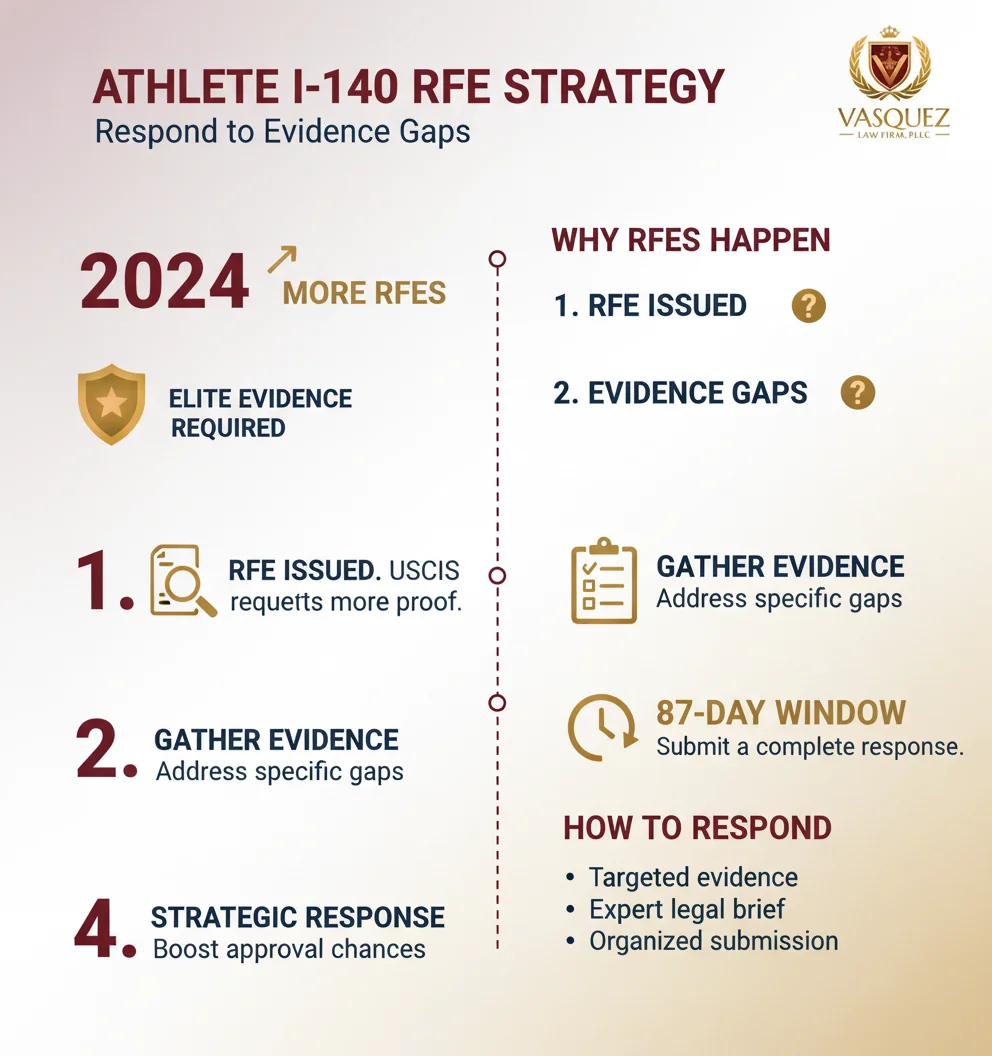
If you have a pending or soon-to-file athlete petition, the fastest wins are usually evidence organization, letter correction, and timeline planning. Treat this like an internal “RFE drill.”
1) Triage your case: pending vs. filing soon
- Pending filing: You may still have time to tighten the packet before submission.
- Already filed: Start collecting missing items now so you can respond quickly if an RFE arrives.
2) Audit for “minimum evidence” gaps
Look for obvious omissions: unsigned letters, missing translations, unclear league standing, no proof of salary/contract terms, or exhibits that don’t match what the letter claims.
3) Protect timing and travel plans
Even without discussing strategy specifics here, the key is to avoid assumptions. If your competition schedule depends on approval timing, build contingency time as if an RFE will happen.
If this situation applies to you, take these steps NOW:
- Step 1: Create a single timeline document (dates of entry, current status end date, signing date, season start, planned travel, and filing/receipt dates).
- Step 2: Re-check all support letters for specific facts (rankings, league level, awards, media reach) and match each claim to an exhibit.
- Step 3: Confirm all documents are properly signed, dated, translated (if needed), and consistently spell names, teams, and event titles.
- Step 4: Consult with a legal expert to understand your rights and options
Warning Signs & Red Flags to Watch For
RFEs often follow predictable patterns. If any of the items below are true, your petition may be at higher risk.
Red flags in recommendation letters
Letters that sound generic or that don’t prove “how the signer knows” the athlete are a common trigger for follow-up questions.
Red flags in exhibits and proof
USCIS officers look for documents that a neutral third party would accept. Screenshots without source context, missing circulation metrics, or unverifiable awards can be discounted.
Red flags in timing and consistency
If your packet says one thing and your record shows another (dates, teams, titles), an officer may question the reliability of the entire filing.
These are signs your case may be in jeopardy:
- Your petition relies on a “template” letter that doesn’t describe the signer’s credentials, relationship to you, or specific achievements.
- Your evidence is heavy on social media screenshots but light on official league records, awards criteria, or independent media coverage.
- Your exhibits don’t clearly prove the level of competition (for example: league tier, national ranking, or selection process).
Seeing these signs? Vasquez Law Firm, PLLC has handled hundreds of denied claims in North Carolina. Attorney Vasquez knows the tactics insurers use. Get a free case evaluation.
Your Rights: What You CAN and CANNOT Do
When an RFE happens (or is likely), your rights and limits matter. A careful response can strengthen the case; a rushed response can create new contradictions.

What you CAN do during an RFE window
You can usually submit additional evidence, clarify inconsistencies, and provide more detailed letters—so long as the submission matches the category requirements and the request.
What you CANNOT do without risk
You generally cannot ignore the RFE, submit unrelated materials, or “paper over” missing facts with vague letters. Officers often compare the new submission to the original record for credibility.
YOU HAVE THE RIGHT TO:
- Receive a written notice explaining what USCIS believes is missing and the deadline to respond.
- Submit organized, relevant evidence that directly answers each item in the RFE.
- Use credible experts (coaches, league officials, journalists) to clarify competition level and achievements—when those experts provide specific facts.
YOU CANNOT:
- Miss the RFE deadline—late responses are commonly rejected, and the petition can be denied.
- Assume USCIS will “connect the dots” if your exhibits are unlabelled, untranslated, or not tied to specific claims.
Vasquez Law Firm, PLLC helps North Carolina clients understand and protect their rights every day.
Documents You'll Need (Save This Checklist)
Athlete petitions tend to rise or fall on documentation quality. The goal is to show not only that you compete—but that your achievements meet the legal standard for the category you are using.
Official league and competition records
USCIS generally gives more weight to official records than self-published content. If a stat page exists, capture it with source context and, when possible, obtain letters from league offices.
Media, awards, and third-party recognition
Independent coverage matters. The more the source can be verified (publisher, circulation, date, author), the stronger it typically is.
Contracts, remuneration, and role evidence
Clear contracts, pay evidence, and role descriptions can help show the level of work and the nature of the opportunity—especially when compared to others in the field.
Gather these documents NOW (before they disappear):
- Official league documentation (standings, rankings, roster confirmations, match records, statistics pages).
- Award proof (criteria, selection process, and evidence you received it—plus who issued it and why it is significant).
- Independent media coverage (full articles with publication info, not just screenshots).
- Contracts and deal terms (team contract, endorsement agreements, agent agreement if relevant).
- Letters from credible experts (signed, dated, with the signer’s credentials, and specific examples of your achievements).
Tip: Keep all documents organized in one folder - it makes the process much easier.
KEY TAKEAWAY:
In athlete-based petitions, it’s not enough to be talented. USCIS wants verifiable, organized, third-party evidence that matches the exact legal criteria—otherwise an RFE can delay everything.
Legal Background and Context
USCIS issues RFEs under its general adjudications authority. In practice, RFEs often appear when (1) a required initial item is missing, or (2) the officer believes the record does not establish eligibility by a preponderance of the evidence.
Where RFEs come from (in plain English)
USCIS can request missing initial evidence or additional evidence. The agency’s processes are explained in its policy materials and forms instructions, which are published at USCIS.gov.
Why athletes see RFEs in I-140 filings
Many pro athletes pursue EB-1 (extraordinary ability) or other employment-based categories, where USCIS scrutinizes whether achievements are sustained, nationally or internationally recognized, and supported by objective proof. The governing rules frequently cited in these cases include the employment-based immigrant visa framework at 8 U.S.C. § 1153 and petition standards at 8 C.F.R. § 204.5.
Travel and visa processing considerations
Some athletes also coordinate consular processing or visa stamping for travel, tournaments, or re-entry. For official visa and travel guidance, consult the U.S. Department of State’s visa information. If a matter escalates into immigration court proceedings (not typical for most athlete petitions, but possible in certain situations), the court system information is available via the Executive Office for Immigration Review (EOIR).
How Vasquez Law Firm, PLLC Helps North Carolina Clients Win These Cases
For 15 years, Vasquez Law Firm, PLLC has helped individuals and families navigate complex immigration filings. Attorney Vasquez, JD is admitted to the North Carolina State Bar and the Florida Bar, and our team works with English- and Spanish-speaking clients (Se Habla Español) across North Carolina.
How we approach athlete RFEs (and how we try to prevent them)
A strong petition is built like a courtroom exhibit binder: every claim has proof, and every proof has a label and explanation. When a case is filed quickly due to season timing, we focus on “minimum requirements” first—then strengthen the discretionary or higher-level evidence.
Our case process (high level)
Learn more about our Immigration Law services and the team supporting these filings.

- Step 1: We identify the correct category strategy and the evidence gaps that tend to trigger RFEs.
- Step 2: We build a clean evidence map (claim → exhibit → explanation) so the officer can verify facts quickly.
- Step 3: We review recommendation letters for specificity, credibility, and consistency with the record.
- Step 4: If an RFE comes, we draft a point-by-point response that answers exactly what was asked—no filler.
Real example from our practice
Real example: “We helped a high-level athlete who had strong achievements but inconsistent documentation across leagues and seasons. We rebuilt the evidence index, obtained corrected letters from a league official and coach, and submitted official match records with clear translations and citations. The case moved forward after the officer’s questions were answered with verifiable proof.” — Attorney Vasquez
If you want to learn more about the professionals behind this work, visit our Attorney Vasquez page.
Frequently Asked Questions (Specific to This Situation)
1) What does “minimum requirements” mean for an athlete I-140?
It means USCIS expects certain baseline items to be present and coherent when the I-140 is filed—such as required initial evidence for the category, properly executed forms, and enough supporting proof to evaluate eligibility. If the filing is missing required initial evidence, USCIS may issue an RFE (or in some situations deny). An immigration lawyer typically treats “minimum requirements” as a checklist that must be satisfied before adding optional strengthening materials.
2) Why do athlete recommendation letters trigger RFEs?
Because letters can be vague, repetitive, or unsupported by documentation. USCIS often wants letters to explain: who the signer is, why the signer’s opinion matters, how they know the athlete’s work, and specific achievements with dates and context. If a letter makes claims that don’t match exhibits (rankings, awards, league level), it can invite follow-up questions.
3) If my packet uses a PLC, what kinds of gaps can cause an RFE?
Cases relying on a prior labor-related step can draw RFEs when USCIS thinks key evidence is missing, unclear, or does not show eligibility at filing. Common trouble spots include incomplete role descriptions, unclear evidence of the athlete’s level of competition, or documents that don’t line up with the petition narrative. The safest approach is to ensure every claimed fact is backed by a reliable exhibit and that the packet tells one consistent story.
4) I’m living in North Carolina—does my location change how USCIS reviews the I-140?
Your physical location in North Carolina typically does not change the legal standard USCIS applies to an I-140. However, practical issues can change: where you can obtain records, how quickly you can get original signatures, and whether your club, training facility, or league contacts can produce official documentation on short notice. Planning ahead is especially important if you train in multiple states during the season.
5) How long can an RFE delay an athlete’s case?
It depends on the deadline given in the RFE and how quickly you can collect credible evidence. Many RFEs require a response within a fixed window, and then USCIS needs additional time to review the response. Delays can be longer if the RFE reveals deeper issues (like inconsistent dates, unclear league level, or questionable award significance). An immigration lawyer can help you prioritize evidence that directly answers the officer’s questions.
6) Can an RFE affect travel for tournaments or competitions?
An RFE itself is not a travel document, and travel impacts depend on your broader immigration posture (current status, pending applications, and consular processing needs). Because travel mistakes can create serious consequences, athletes should use official sources for baseline rules and then get individualized legal advice for their facts. Start with the U.S. Department of State visa page for general information.
7) If USCIS denies after an RFE, what options might exist?
Depending on the case, options may include a motion to reopen/reconsider, an appeal where permitted, or a refiling with a stronger record. The best option depends on why the denial happened: missing initial evidence, credibility issues, failure to meet the legal criteria, or a mismatch between category and proof. Reviewing the denial language carefully is critical before deciding next steps.
Don't Navigate This Alone
If you're dealing with athlete-based I-140 filings and an RFE risk, Vasquez Law Firm, PLLC can help. With 15+ years serving North Carolina, we know what works.
Free consultation. Bilingual team. No fees unless we win.
Call Now: 1-844-967-3536
Se Habla Español - Hablamos Su Idioma
Free Legal Consultation
Discuss your case with our experienced attorneys. We're available 24/7.
Vasquez Law Firm
Legal Team
Our experienced attorneys at Vasquez Law Firm have been serving clients in North Carolina and Florida for over 20 years. We specialize in immigration, personal injury, criminal defense, workers compensation, and family law.