Immigration Lawyer ALERT: Athlete RFEs Can Sink I-140s
Immigration lawyer explains new athlete RFE risk for I-140/PLCs. Avoid denials—get help from Vasquez Law Firm, PLLC. Se Habla Español.
Vasquez Law Firm
Published on December 23, 2025
Immigration Lawyer ALERT: Athlete RFEs Can Sink I-140s
An immigration lawyer can spot a problem that many athletes and teams miss until it is too late: when a petition does not include the “minimum requirements,” USCIS may respond with a Request for Evidence (RFE) instead of an approval. The recent news about professional athletes and RFEs tied to PLCs and I-140 filings is a warning shot for anyone building an employment-based case—especially if you are training, touring, or competing with tight schedules and cross-border travel.
Quick Summary (Read This First)
What happened: A recent report highlights that USCIS may issue RFEs for professional athletes when a PLC (labor certification) or an I-140 filing does not meet minimum evidentiary requirements.
Why it matters to you: If you are an athlete, coach, trainer, or sports organization in North Carolina, an RFE can delay work authorization planning, travel, and season commitments—and a weak response can lead to denial.
What to do now: Confirm what was filed, identify the exact eligibility category (and required evidence), and prepare a structured RFE-ready evidence package before USCIS asks for it.
What This News Means for North Carolina Residents
Why this matters now for athletes and teams
In a fast-moving sports career, timing is everything. A single RFE can push a case back weeks or months, and that can affect competition schedules, contracts, and travel. This is especially true for professional athletes who travel often and rely on clean, consistent documentation across seasons.
According to this BAL Immigration Law report on athlete RFEs for PLCs and I-140 filings, USCIS may require RFEs when the filing does not contain minimum requirements. That means the “front end” of the petition matters more than ever.
What this can look like in North Carolina
We see many sports-related immigration cases connected to training facilities, universities, semi-pro leagues, and performance organizations. If you live in North Carolina (for example, around Charlotte, Raleigh, Durham, or the Triad), your case may be prepared locally but decided by USCIS service centers that apply strict national standards.
An RFE is not a denial. But it is also not “routine paperwork.” It is a sign USCIS believes something essential is missing or unclear.
Who is most at risk after this news
This news should get the attention of:
- Professional athletes seeking an employment-based green card path (often via I-140)
- Sports clubs, teams, and sponsors filing on behalf of talent
- Athletes using agents and third parties to gather evidence
- Anyone whose case depends on complex work itineraries, seasonal contracts, or international competitions
KEY TAKEAWAY:
If the initial filing does not include “minimum requirements,” an RFE can become a built-in delay—especially for athletes with tight season timelines and international travel.
What to Do in the Next 24-48 Hours
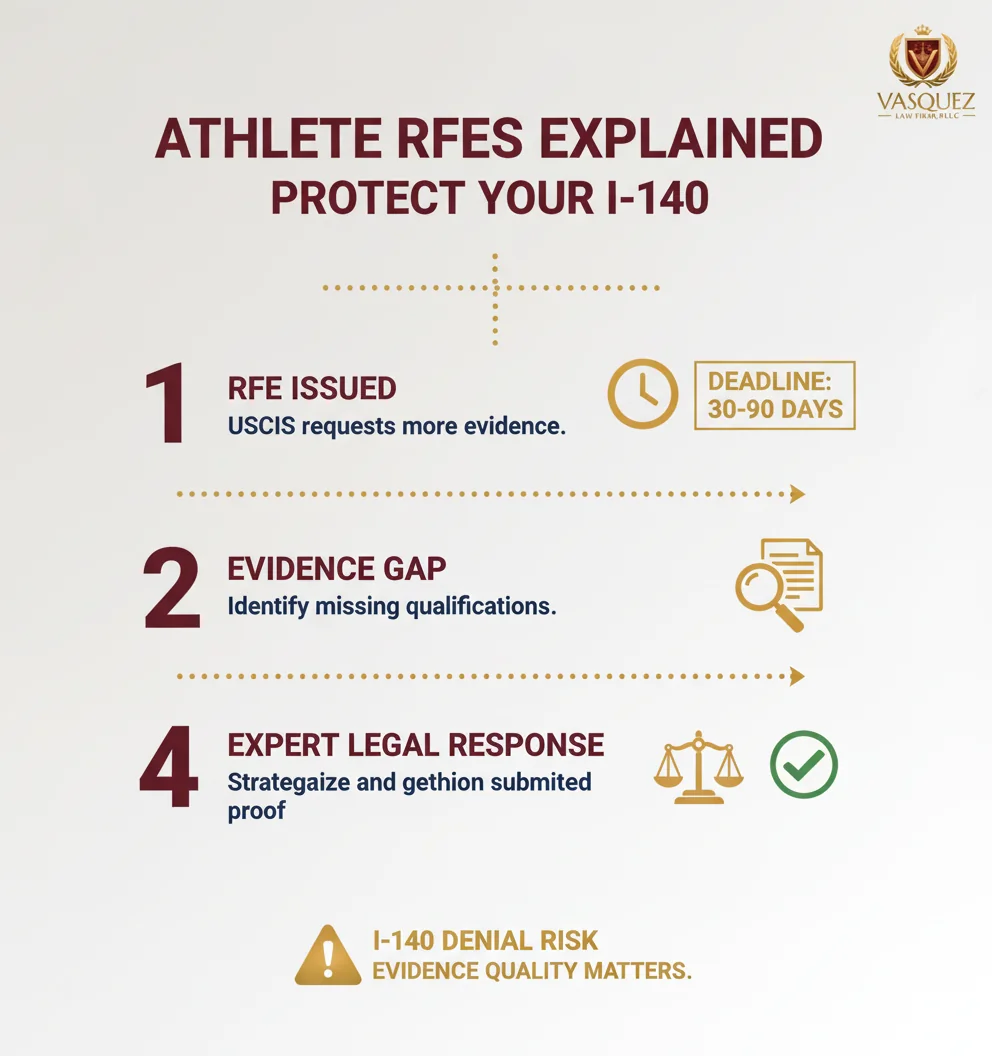
1) Confirm exactly what was filed
Do not rely on a summary email or a quick message from a third party. Get the full copy of the filing package (every form, exhibit, and supporting letter) and confirm:
- The immigration category used (and why)
- Which petitioner signed (team, employer, agent, or self, depending on category)
- Whether premium processing was requested (if eligible)
- What evidence was included to meet minimum requirements
2) Identify “minimum requirement” gaps before USCIS does
A strong response starts before the RFE arrives. In many athlete-related filings, common gaps include missing proof of:
- Comparable evidence tied to the correct regulatory criteria
- Contracts, event itineraries, and consistent wage/work details
- Sustained national or international recognition (not just social media popularity)
- Clear expert letters that explain significance, not just praise
3) Build an RFE response timeline
RFEs have deadlines. Missing one can end the case. Even before an RFE is issued, assign responsibility for gathering evidence, translations, and letters, and decide who will track deadlines.
If this situation applies to you, take these steps NOW:
- Step 1: Download and save the full filing package (forms + exhibits) and your USCIS receipt notice.
- Step 2: Create a one-page evidence map that matches each eligibility criterion to specific proof (contracts, rankings, press, awards, letters).
- Step 3: Collect objective records now (league stats, official rankings, event programs, independent media) and do not depend on “future wins.”
- Step 4: Consult with a legal expert to understand your rights and options
Warning Signs & Red Flags to Watch For
Red flags we see in athlete I-140 and related filings
When USCIS expects minimum requirements, these issues can quickly trigger an RFE or denial.
Red flags tied to PLC/labor certification timelines
If your strategy involves labor certification (PERM/PLC) steps, the “paper trail” needs to be clean and consistent from the start. Inconsistencies between recruitment, job duties, and the petition can be costly.
These are signs your case may be in jeopardy:
- Your petition relies heavily on social media posts, screenshots, or self-published articles instead of independent coverage and official records.
- Recommendation letters are generic (or all from friends/teammates) and do not explain why your achievements meet the legal criteria.
- Your contracts, itineraries, or job duties conflict across documents (dates, employer names, compensation, or location).
Seeing these signs? Vasquez Law Firm, PLLC has handled hundreds of denied claims in North Carolina. Attorney Vasquez knows the tactics insurers use. Get a free case evaluation.

Your Rights: What You CAN and CANNOT Do
Your rights during the USCIS RFE process
An RFE is a request for more proof. You typically have the right to respond with organized evidence and legal argument, as long as you meet the deadline listed on the notice.
Your rights (and risks) with travel while a petition is pending
Travel can be risky depending on your current status (for example, O-1, P-1, F-1, H-1B) and what else is pending (including adjustment of status). Always confirm your exact posture before leaving the U.S., because a pending or approved petition is not the same thing as a visa stamp.
YOU HAVE THE RIGHT TO:
- Receive a written RFE that identifies what USCIS believes is missing and sets a response deadline.
- Submit additional evidence, expert opinions, and a legal brief explaining how you meet the criteria.
- Request your own immigration counsel to prepare and organize the response you file.
YOU CANNOT:
- Ignore the RFE deadline or assume USCIS will grant extra time informally.
- Send scattered documents without a clear exhibit list and explanation—disorganized responses often fail even when good evidence exists.
Vasquez Law Firm, PLLC helps North Carolina clients understand and protect their rights every day.
Documents You'll Need (Save This Checklist)
Core evidence USCIS expects for athlete-strength cases
Different categories have different criteria, but USCIS consistently responds well to objective, third-party proof.
How to make letters persuasive (and safer)
Letters should explain facts, rankings, and significance in plain language. They should also explain how the writer knows your work and why your achievements stand out compared to peers.
Gather these documents NOW (before they disappear):
- Official contracts, offer letters, and amendments (with consistent dates and terms).
- League or federation records: rankings, statistics, match results, and season summaries.
- Independent media coverage (not self-published), including interviews and event reports.
- Awards documentation: criteria, selection process, and who competed for the award.
- Itineraries and event programs showing your role (starter, captain, key competitor, featured performer).
Tip: Keep all documents organized in one folder - it makes the process much easier.
KEY TAKEAWAY:
For many athlete petitions, “minimum requirements” means USCIS expects a clear category match plus objective proof—contracts, rankings, and independent recognition—not just potential and hype.
Legal Background and Context
Why USCIS issues RFEs
USCIS reviews petitions under detailed regulations and may request more evidence when the filing does not establish eligibility at the time of filing. In many contexts, USCIS can issue an RFE under rules that govern evidence and adjudications (often discussed under 8 C.F.R. § 103.2(b)(8)). You can read general USCIS filing expectations on the official site at USCIS.gov.
Why I-140 structure matters for athletes
The I-140 is used for several employment-based immigrant categories. For athletes, strategies often involve extraordinary ability concepts (for example, EB-1) or other employment-based pathways depending on the facts. The legal standards are strict: you must show you meet specific criteria with specific evidence, and the evidence must be credible and well-organized.
How consular processing and visas intersect with petition timing
Many athletes also need to understand visas and consular processing. Petition approval is different from visa issuance. The U.S. Department of State explains visa processes at travel.state.gov (U.S. visas). If someone ends up in immigration court, proceedings are handled through EOIR, with information available at justice.gov/eoir.
Because many sports careers involve urgent scheduling, working with an immigration lawyer early can help reduce the risk of an avoidable RFE and help you respond in a way that matches USCIS’s checklist mindset.
How Vasquez Law Firm, PLLC Helps North Carolina Clients Win These Cases
How we reduce RFE risk before USCIS asks questions
Our team at Vasquez Law Firm, PLLC focuses on building petitions that are easy to approve: clear category fit, clear evidence mapping, and clear credibility. Attorney Vasquez, JD—licensed with the North Carolina State Bar and the Florida Bar—brings 15 years of immigration experience to complex, document-heavy cases.
How we structure an RFE response so it is not “just a document dump”
A strong RFE response is organized like a persuasive report. It typically includes an exhibit list, a legal argument that tracks the exact criteria, and evidence that directly answers the questions asked.
Serving North Carolina residents with high-stakes timelines
When clients are based in North Carolina, we also plan around practical realities like training camps, travel, and event dates. We build timelines for letters, translations, and signatures so the case does not collapse under deadline pressure.
Our experienced team, led by Attorney Vasquez, has helped hundreds of North Carolina clients. Here's exactly how we help:
- Step 1: We review your case for free and tell you honestly if you have a claim
- Step 2: We handle all paperwork and deadlines so nothing gets missed
- Step 3: We fight insurance tactics - we know their playbook
- Step 4: We maximize your settlement or take it to hearing if needed
Real example: "We helped a semi-pro athlete living in North Carolina whose petition was headed for an RFE because the evidence did not match the legal criteria. We rebuilt the exhibit list, added objective league records, corrected contract inconsistencies, and submitted stronger expert letters. USCIS accepted the response and the case moved forward without a denial." - Attorney Vasquez

KEY TAKEAWAY:
The best “RFE strategy” is an approval-ready filing: a clean evidence map, consistent contracts, and independent proof that matches the exact category requirements.
Frequently Asked Questions (Specific to This Situation)
1) What does “minimum requirements” mean for a pro athlete I-140 filing?
It means USCIS expects the petition to contain enough evidence at the time of filing to show you qualify under the chosen category. For athletes, that usually means objective proof tied to specific criteria (rankings, contracts, independent media, awards, comparable evidence) rather than general praise.
2) If my employer started a labor certification (PLC/PERM), can USCIS still issue an RFE later?
Yes. The PERM/PLC step does not guarantee the I-140 will be straightforward. USCIS may still issue an RFE if the petition package is missing required items, contains inconsistencies, or does not clearly establish eligibility for the immigrant category.
3) I compete in multiple states and countries—how should itineraries be documented to avoid an RFE?
USCIS typically looks for a clear, verifiable schedule and role. Provide event invitations, official programs, contracts, and letters from organizers. The key is consistency across dates, locations, and who is sponsoring or employing you.
4) Are recommendation letters enough to answer an athlete RFE?
Usually not by themselves. Letters work best when they point to objective proof: rankings, stats, awards criteria, and independent media. A strong letter explains significance (why your accomplishments matter in your sport), not just that you are talented.
5) If I paid for premium processing, does that stop RFEs?
No. Premium processing speeds up adjudication timeframes in eligible cases, but it does not reduce the evidence required. In some cases, faster review can mean faster issuance of an RFE if the initial filing is thin.
6) Does it matter that I live and train in North Carolina if USCIS reviews my case elsewhere?
Your residence in North Carolina does not change the federal legal standards, but it affects practical case planning. Local training and competition records can be easier to gather, and travel planning is important if you have pending steps that depend on status or visa stamping.
7) If USCIS denies after an athlete RFE, what options might exist?
Options depend on the category and the reason for denial. Some cases allow motions to reopen/reconsider, refiling with stronger evidence, or shifting to another strategy (including nonimmigrant options in the short term). A careful denial analysis is essential because deadlines and best options vary by posture.
Don't Navigate This Alone
If you're dealing with an athlete-related RFE risk or a pending I-140/PLC strategy, Vasquez Law Firm, PLLC can help. With 15+ years serving North Carolina, we know what works.
Free consultation. Bilingual team. No fees unless we win.
Call Now: 1-844-967-3536
Se Habla Español - Hablamos Su Idioma
Free Legal Consultation
Discuss your case with our experienced attorneys. We're available 24/7.
Vasquez Law Firm
Legal Team
Our experienced attorneys at Vasquez Law Firm have been serving clients in North Carolina and Florida for over 20 years. We specialize in immigration, personal injury, criminal defense, workers compensation, and family law.